Mugwort oil is steam-distilled from the leaves and tops of Artemisia vulgaris (ngải cứu). Its main components are 1,8-cineole, camphor, borneol and thujone. Their proportions vary widely with growing region and harvest season.
Because it contains thujone, this is the oil that needs the most caution in our herbal range. Use it only at very low dilution. It is not for pregnant or breastfeeding women, children or people with epilepsy.
Quick facts
- Scientific name
- Artemisia vulgaris L.
- Trade name
- Mugwort oil
- Part used
- Leaves and tops
- Method
- Steam distillation
- Appearance & odour
- Pale yellow to greenish-yellow; sharp, warm herbal scent, slightly camphoraceous
- Main components
- 1,8-cineole, camphor, borneol, thujone; proportions vary by region and season
- Storage
- Dark glass bottle, tightly closed, in a cool place, out of reach of children
What is mugwort oil?
Mugwort (ngải cứu, also called ngải diệp) is a herb of the daisy family. In Vietnam it grows in home gardens and is sold at every vegetable market. Crushed, the leaves smell sharp and bitter, a little like camphor.
Steam-distilling the leaves and tops gives a small amount of pale yellow to greenish-yellow oil. It has a warm, pungent herbal scent with a cool edge from cineole and camphor.
On the international market, the oil is sold as “mugwort oil”. Its composition changes from region to region, so every lot needs its own chromatogram.
What does the plant look like, and where does it grow?
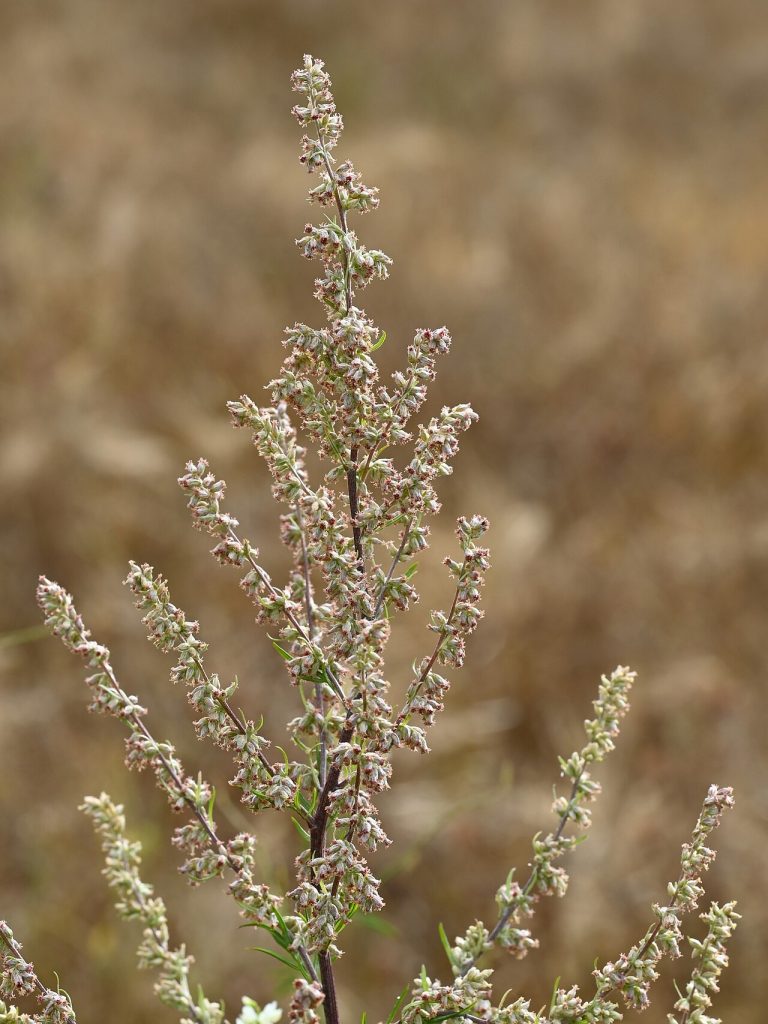
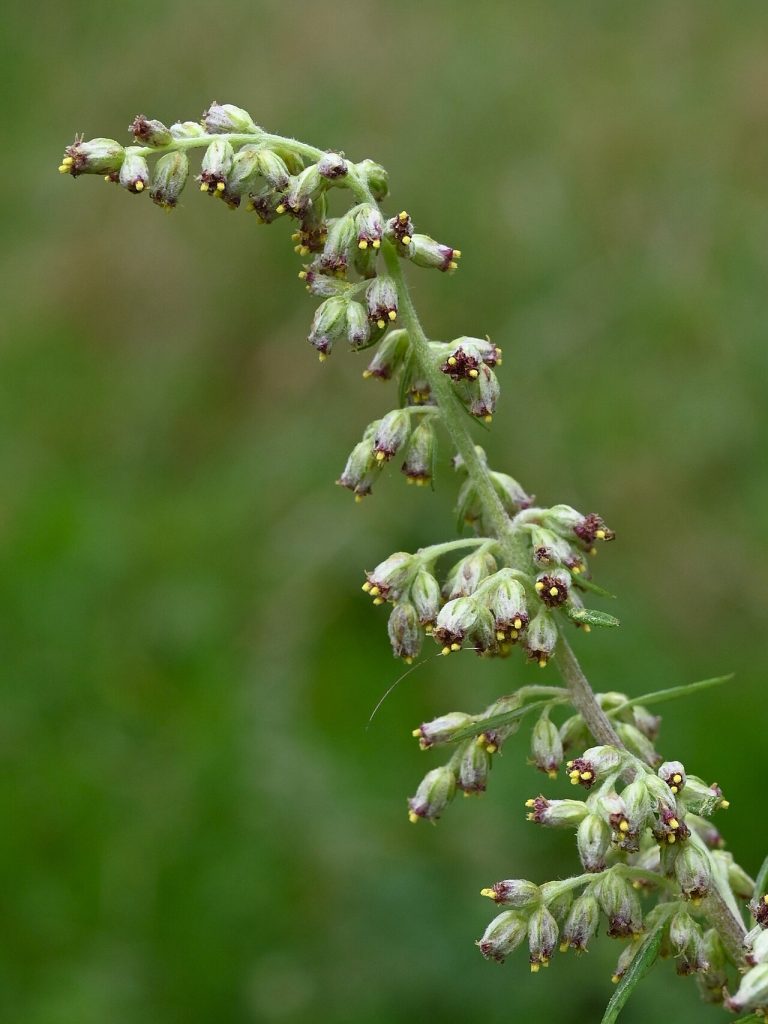
According to Do Tat Loi’s reference work on Vietnamese medicinal plants, mugwort is a perennial herb about 0.5–0.6 m tall, with a grooved stem. The leaves are alternate and deeply lobed. The upper side is dark green; the underside is greyish-white with fine hairs. The small flowers grow in clusters.
Mugwort grows wild in many parts of Vietnam, and also across Asia and Europe. In Vietnam it is mostly grown as a vegetable around homes and in peri-urban vegetable areas.
Some farms also grow it as a field crop. In 2022, Phong Hoa cooperative (Hoa Lu area, Ninh Binh) grew 2 ha of mugwort, harvested it year-round and sold it under an offtake contract.
Mugwort in Vietnamese life
Most Vietnamese know mugwort first as food: omelette with mugwort, chicken stewed with mugwort, mugwort soup. Do Tat Loi records that the leaves are usually picked around June, close to the Doan Ngo festival (the 5th day of the 5th lunar month). This is also when many families pick mugwort to dry and keep.
Dried leaves are ground and sieved to collect the white, woolly fibres, called ngải nhung. This “moxa wool” is used for moxibustion alongside acupuncture.
Mugwort oil, moxa and sweet wormwood
| Criterion | Mugwort oil | Mugwort as food, moxa | Sweet wormwood |
|---|---|---|---|
| Species | Artemisia vulgaris | Artemisia vulgaris | Artemisia annua |
| Form | Steam-distilled oil, highly concentrated | Fresh leaves in food; dried leaves and moxa wool | Leaves and tops |
| Key point | Contains thujone and camphor; external use only, low dilution | Used at food or remedy amounts | Source of artemisinin, a different plant |
| Common confusion | “The vegetable is safe, so the oil must be too” | — | Both are loosely called “ngải” |
Eating mugwort or using moxa is not the same as using the oil. The oil concentrates the volatile compounds, including thujone, and needs its own dosing rules.
Uses
Traditional use
According to Do Tat Loi, traditional Vietnamese medicine describes mugwort as pungent and slightly warming. The leaves (as a decoction or infusion) are used:
- to warm the blood and qi and dispel cold and damp, and to regulate menstruation;
- for abdominal pain caused by cold and for irregular periods;
- for nosebleeds and vomiting of blood, in set remedies.
Moxa wool is burned over acupoints, usually on a slice of ginger to avoid burns. These uses apply to the leaves and moxa, not to the essential oil.
What research says
- Mosquito repellency: a 1985 study isolated several mosquito repellents from mugwort, tested against Aedes aegypti: camphor, borneol, thujone, cineole and terpinen-4-ol. These results come from tests on individual compounds.
- Antibacterial and antifungal: a 2019 study from Brazil found that mugwort oil killed Staphylococcus aureus and the yeast Candida albicans in laboratory tests.
- Thujone toxicity: the European Medicines Agency (EMA) notes that high doses of thujone cause convulsions. It advises minimising use in pregnant women and children.
For information only; not a substitute for medical advice.
Industrial applications
| Industry | Applications |
|---|---|
| Perfume | Green, sharp herbal note (at very low levels) |
| Household | Minor ingredient in insect-repellent products and scent sachets |
| Cosmetics | Very limited, because of thujone limits |
Scent profile and blending
Mugwort smells bitter, sharp, green and slightly camphoraceous. In a blend, a very small amount is enough to add a rustic herbal note.
- Blend with Java citronella for a softer-smelling repellent blend.
- Blend with clove basil and Thai basil for the warm herbal scent of a Vietnamese steam bath.
How to use at home
- Room diffusing (adults): 1–2 drops in a diffuser, in a ventilated room, for no more than 30 minutes.
- Deter mosquitoes and insects: 1–2 drops of mugwort with 4–5 drops of Java citronella on cotton, placed in room corners or on window sills.
- Wardrobe sachet: 2–3 drops on wood shavings in a cloth bag, hung out of children’s reach.
- Massage (adults): dilute below 1%, i.e. at most 1–2 drops in 10 ml carrier oil.
Safe use
- Do not use for pregnant or breastfeeding women, children, or anyone with epilepsy or a history of seizures.
- Keep the dose low: below 1% on skin; never apply undiluted; patch-test on the wrist first.
- People allergic to daisy-family plants (chrysanthemum, wormwood, ragweed) should avoid it.
- Do not swallow, not even “a few drops in water”. If swallowed, do not induce vomiting; call 115 (Vietnam emergency) or go to a medical facility at once, and bring the bottle.
- Keep away from children and pets. Do not diffuse in a room with cats or dogs.
How to recognise good oil and store it
- Good oil is clear, pale yellow to greenish-yellow, with a distinct sharp herbal scent and no burnt note.
- Mugwort oils from different regions may be heavier in cineole, or in camphor and thujone. Ask for the lot chromatogram before using it in a product.
- Keep tightly closed, in a cool place, away from sunlight. Best used within about 2 years.
Why is mugwort oil rare and expensive?
Mugwort leaves contain very little oil. A study from Brazil obtained about 0.5% oil from dried leaves. Fresh leaves contain a lot of water, so the yield per fresh weight is even lower.
This means tonnes of leaves are needed for a few kilograms of oil. Because composition also varies by region, every lot must be tested. That is why mugwort oil costs much more than common herbal oils.
Composition varies by region and season
Studies show that mugwort from different regions gives different oils. Oil from Italy is rich in camphor; oil from Germany in sabinene, myrcene and 1,8-cineole; oil from Morocco in camphor and thujone.
Do Tat Loi records that the main components of Vietnamese mugwort oil are cineole and α-thujone. This is why the company tests every lot and states the thujone content on the COA.
Quality specifications
The main parameter is the chromatogram: 1,8-cineole, camphor, borneol and thujone (α and β). Together with relative density and refractive index, thujone content decides which applications a lot is suitable for. Every lot comes with a COA and MSDS.
Reference figures; actual values follow the COA of each lot.
Why source mugwort oil from Vietnam?
Mugwort is an everyday crop in Vietnam. It is grown as a vegetable around homes and in peri-urban areas, and some cooperatives now grow it in fields that are cut several times a year.
That makes leaf supply local and familiar to farmers. Leaves can reach the still quickly, either fresh or shade-wilted, which helps keep the volatile oil in the leaf.
What buyers usually ask for
Fragrance houses, formulators and distributors typically ask for:
- COA (certificate of analysis) for the lot, with thujone content stated.
- GC-MS or GC chromatogram showing 1,8-cineole, camphor, borneol and thujone.
- MSDS / SDS for handling and transport.
- A sample before contract, to check scent and fit in their own formula.
- Regulatory review on their side, since thujone limits apply in many markets.
If you need mugwort oil for a product line, contact us to discuss volumes and documents.
Growers & cooperatives
The company buys mugwort leaves and tops for distillation. We accept both cultivated (vegetable) mugwort and wild plants, as long as the species is correct. Priority areas:
- Peri-urban vegetable areas of northern Vietnam with mugwort fields grown for market.
- Ninh Binh, where a cooperative already grows mugwort as a field crop.
- Other areas: send a sample first so we can test the oil.
Raw material requirements:
- Mature (not too young) leaves and tops, cut in dry weather; remove old stems and roots.
- No weeds or other plants. On a first sale, send a photo of the leaf underside (greyish-white and hairy).
- If pesticides were used, the pre-harvest interval on the label must be respected, and the company must be told.
- Deliver fresh on the same day, or shade-wilted; do not dry in strong sun, which drives off the oil.
Mugwort is planted once and cut many times. Do Tat Loi records that the leaves are usually picked around June.
The oil yield is low, about 0.5% of dried leaf in the reference study; the company reports results after testing your sample. To talk about selling mugwort, call or message on Zalo: +84 983 299 529. See more on the Raw material sourcing page.
Extraction process
- Cut leaves and tops; remove old stems and foreign matter.
- Shade-wilt, or distil fresh straight away.
- Steam-distil and separate the oil layer.
- Settle, filter and remove water.
- Run chromatography, record thujone content and keep the COA under the lot code.
Frequently asked questions
Mugwort is edible, so is mugwort oil safe?
Not in the same way. The oil concentrates thujone, so use it externally only, at very low dilution, and keep it away from sensitive groups.
Can pregnant women use mugwort oil?
No. Pregnant and breastfeeding women should not use mugwort oil in any form.
Does mugwort oil repel mosquitoes?
Several compounds found in mugwort repelled mosquitoes in tests. At home, use 1–2 drops blended with Java citronella rather than a large amount.
Is mugwort the same as sweet wormwood?
No. Sweet wormwood is Artemisia annua, the source of artemisinin. Mugwort is Artemisia vulgaris.
Can I use the oil instead of moxa wool?
No. The oil is flammable and can cause burns; moxibustion uses dry moxa wool.
Why is mugwort oil expensive?
The leaves contain very little oil, so a lot of raw material gives a small amount of oil. Each lot also has to be tested for thujone.
I grow mugwort for the vegetable market. Can I sell to the company?
Yes. Tell us your area and number of cuttings per year, and send a sample so we can test the oil first.
Why does the COA state thujone content?
Thujone is the compound that limits how the oil can be used. Buyers need the figure to check their own regulatory limits.
Read more: Mature coriander oil Clove basil oil Camphor oil Vietnamese herbal essential oils
Supplying mugwort raw material, or interested in contract growing?
Thảo Dược Xanh buys raw materials and provides technical support to farmers and cooperatives in Vietnam.
References: Mugwort – Do Tat Loi, Medicinal Plants of Vietnam · Essential oil of Artemisia vulgaris cultivated in Brazil (Pharmaceuticals, 2019) · EMA: Public statement on thujone (2012)