Clove basil oil is steam-distilled from Ocimum gratissimum plants cut at flowering. Its main component is eugenol (about 45–80%, depending on the variety), so it smells close to clove: warm and spicy.
In traditional Vietnamese medicine, clove basil is a remedy for colds. Eugenol from clove basil is used in dentistry, oral-care products, soap and room scents.
Quick facts
- Scientific name
- Ocimum gratissimum L.
- Trade name
- Clove basil oil, African basil oil
- Part used
- Above-ground plant, cut at flowering
- Method
- Steam distillation
- Appearance & odour
- Pale yellow to yellow; clove-like, warm and spicy
- Main components
- Eugenol 45–80% (eugenol type); β-caryophyllene, (Z)-β-ocimene
- Storage
- Dark glass bottle, tightly closed, in a cool place
What is clove basil oil?
Clove basil (hương nhu trắng), also called African basil, belongs to the same family as sweet basil. It is a tall plant with large leaves and a strong, clove-like scent.
Steam-distilling the parts above ground gives a pale yellow to yellow oil with a warm, spicy and long-lasting scent.
What makes clove basil stand out is its high eugenol content, the same compound behind the scent of clove buds. This makes clove basil oil a natural source of eugenol that can be produced in Vietnam. It can partly replace imported clove oil.
What does clove basil look like, and where does it grow?
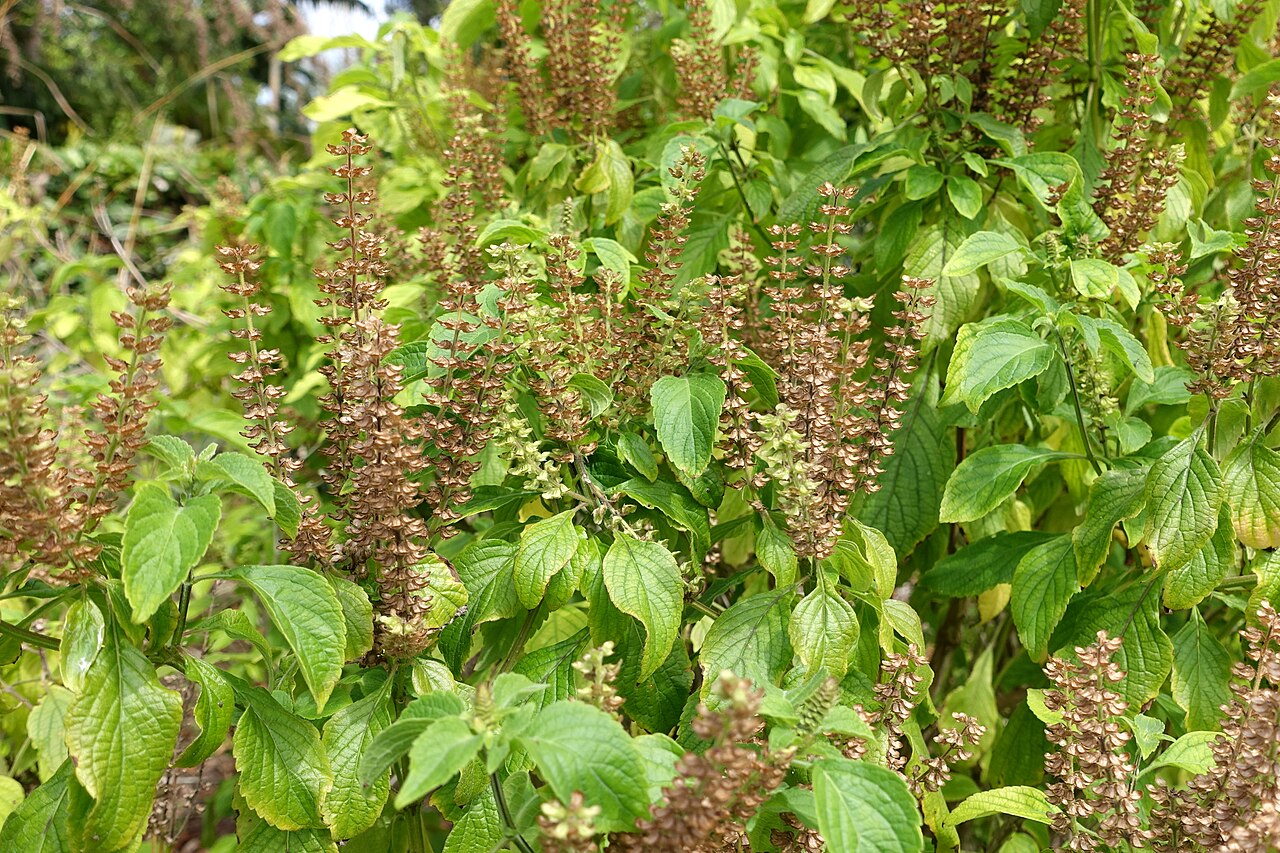
Clove basil is a small shrub, 1–2 m tall, with a square stem that turns woody at the base. The leaves are egg-shaped, toothed at the edges and finely hairy. Small, ivory-white flowers grow in spikes at the tips of the branches. The whole plant smells strongly when crushed.
It grows wild and is cultivated in many parts of Vietnam. It is easy to grow, likes sun and tolerates drought fairly well.
Seed samples have been collected from Phu Tho, Thanh Hoa, Nghe An, Son La, Lai Chau, Dak Lak, Gia Lai, Bac Giang and Thai Nguyen. Even so, Vietnam does not yet have a large commercial growing area for clove basil. This is an opportunity for households and cooperatives that want a short-cycle oil crop.
Clove basil in Vietnamese life
In many villages, clove basil bushes grow around the house. The leaves are boiled for a steam bath when someone has a cold, or for washing hair to leave it fragrant. A traditional steam pot often combines clove basil with citronella, pomelo leaves, mint and Vietnamese balm.
Holy basil (hương nhu tía, a small plant with purple stems) is also used as medicine. But clove basil yields more essential oil, so it is the one chosen for distillation.
Uses
Traditional use
In traditional Vietnamese medicine, clove basil is described as pungent and warming. It is used:
- for heatstroke, colds, fever and headache;
- for stomach ache, vomiting and diarrhoea caused by cold;
- in boiled water for steam baths, hair washing and bathing.
What research says
- Pain relief and antiseptic: eugenol has local anaesthetic, pain-relieving and antiseptic effects. It is a familiar ingredient in dental materials.
- Antibacterial and antioxidant: in laboratory tests, clove basil oil inhibits many bacteria and fungi and shows antioxidant activity.
- Mosquito repellent: in some tests, eugenol-rich oil repelled mosquitoes, but the effect lasted less time than common repellents. In areas with dengue or malaria, mosquito nets and registered repellents are still needed.
For information only; not a substitute for medical advice.
Eugenol: the compound that gives clove basil its value
Eugenol is an aroma compound that smells of clove. In dentistry, eugenol is mixed with zinc oxide to make a temporary filling material. It is also found in toothpaste, mouthwash and perfume, and it is a raw material for making vanillin. Most of the world’s eugenol today comes from clove.
Selected clove basil varieties can give oil with up to about 80% eugenol, close to many clove leaf oils. The plant has a short cycle and can be cut several times, which makes it a notable local source of eugenol.
Industrial applications
| Industry | Applications |
|---|---|
| Dentistry, oral care | Eugenol source for dental materials, toothpaste |
| Cosmetics | Fragrance for soap; spicy notes in perfume |
| Household | Room scents, scent sachets, insect-repellent products |
| Raw material | Isolation of eugenol, synthesis of vanillin |
Scent profile and blending
Clove basil smells warm, spicy and slightly sweet, much like clove. The scent lasts well in a room.
- Blend with orange and cassia for a warm scent suited to cold days.
- Blend with Java citronella to repel mosquitoes.
- Blend with mint for oral-care products and breath sprays (as finished, formulated products).

How to use at home
- Steam inhalation for a cold (adults): 1–2 drops in a bowl of hot water. Cover your head with a towel and breathe the steam for 5–10 minutes with your eyes closed.
- Room scent and mosquito deterrent: 3–4 drops in a diffuser, blended with Java citronella.
- Cupboard and shoe odours: put a few drops on cotton or a cloth bag.
- Scented hair wash: add 1 drop to one dose of shampoo and wash as usual. Do not let it run into the eyes.
A traditional-style steam pot with essential oils
When fresh leaves are not at hand, you can make a quick “steam pot”. Prepare a bowl of freshly boiled water, 1 drop clove basil, 2 drops Java citronella and 1 drop mint.
Sit about 30 cm from the bowl, cover your head with a towel, close your eyes and breathe evenly for 5–10 minutes. Afterwards, dry yourself and avoid drafts.
Do not do this with a high fever or when exhausted. Do not use it for young children, frail elderly people or people with asthma. Place the hot bowl securely to avoid burns.
Safe use
- Eugenol can easily irritate. Do not apply it undiluted to skin or mucous membranes. If used on skin, dilute below 1% (about 2 drops in 10 ml carrier oil) and patch-test on the wrist first.
- Do not put it on an aching tooth yourself; see a dentist for toothache.
- Do not swallow; keep out of reach of children. Do not use during pregnancy or breastfeeding.
- People taking blood thinners or about to have surgery should ask a doctor before use.
- If swallowed, especially by a child, do not induce vomiting. Go to a medical facility at once and bring the bottle.
- Cats are very sensitive to eugenol. Do not diffuse in a room with a cat, and do not apply it to pets’ fur.
How to recognise good oil and store it
- Good oil is yellow and clear, with a distinct, warm clove scent.
- Clove basil has a eugenol-rich type and a thymol-rich type (smelling like thyme), and the two smell completely different. The COA shows which type an oil belongs to.
- Keep tightly closed and away from sunlight. Eugenol-rich oil slowly darkens over time.
Clove basil, holy basil and clove
| Criterion | Clove basil | Holy basil | Clove |
|---|---|---|---|
| Scientific name | Ocimum gratissimum | Ocimum tenuiflorum | Syzygium aromaticum |
| Part distilled | Plant | Plant | Buds, leaves |
| Oil yield | High | Lower | Very high in buds |
| Main components | Eugenol | Eugenol, methyl eugenol | Eugenol |
Quality specifications
The main parameter is eugenol content. A sample grown in Hanoi reached about 80% eugenol. According to Do Tat Loi’s reference work, the fresh plant yields about 0.6–0.8% essential oil. Every lot comes with a COA and MSDS.
Reference figures; actual values follow the COA of each lot.
Why consider clove basil oil from Vietnam?
Clove basil is a short-cycle crop that grows well in Vietnam’s climate. Once planted, it can be cut several times a year for many years.
For buyers who use eugenol, this offers a plant-based source that does not depend only on clove. It can add diversity to supply for oral care, soap and fragrance products.
Commercial growing in Vietnam is still at an early stage. The company is building grower partnerships with selected eugenol-type seed, so raw material can be planned rather than gathered at random.
How it compares with clove oil
Clove oil, from buds or leaves of Syzygium aromaticum, is the established commercial source of eugenol. Well-known clove origins include Indonesia and Madagascar.
Clove basil oil is closer to clove leaf oil than to clove bud oil. Both are eugenol-rich, but the minor components differ, so the scent is not identical.
Clove basil itself is grown in many tropical regions, including Africa and South Asia. Oil from different origins and varieties can be either eugenol-type or thymol-type, so checking the type is essential.
What buyers usually ask for
Buyers in oral care, cosmetics and fragrance typically ask for:
- COA (certificate of analysis) for the lot, including eugenol content.
- GC-MS or GC chromatogram confirming the eugenol chemotype, not the thymol type.
- MSDS / SDS for handling and transport.
- A sample before contract, to test the oil in their own formula against clove leaf oil.
- Growing and harvest information, since chemotype, cutting time and distillation affect the scent.
If you are evaluating clove basil oil as a eugenol source, contact us to discuss your specification and the documents available.
Growers & cooperatives
The company is looking for households and cooperatives to partner in new plantings. Suitable areas include Thanh Hoa, Nghe An, Phu Tho, Son La, Quang Tri, Dak Lak, Gia Lai and the midland provinces.
- Grown from seed; the first cutting comes after about 6 months, then 2–3 cuttings a year. Cut when the plants are in full flower.
- Plant once and harvest for many years. Yield depends on soil, seed and care; the company assesses it together with the grower after the first cutting.
- The company buys fresh plants and distils them right after cutting, because plants left too long or dried in harsh sun lose oil.
- Free seed checked for the eugenol type and free technical support; purchase contracts are signed with growers.
See more on the Raw material sourcing page.
Extraction process
- Cut the plants in full flower and transport them to the still the same day.
- Steam-distil and separate the oil layer.
- Filter and remove water.
- Test for eugenol and keep the COA under the lot code.
Frequently asked questions
How is clove basil different from holy basil?
Holy basil is a small plant with purple stems. Clove basil is taller, with larger leaves and more essential oil, so it is better for distillation.
Can clove basil oil be used for a cold?
In Vietnamese folk practice, a clove basil steam bath helps people sweat and feel better with a cold. A high or long-lasting fever needs a doctor.
Can clove basil oil replace clove oil?
In scent and eugenol content they are close. It is best to test it in the specific formula.
Does clove basil oil repel mosquitoes?
In some tests, eugenol-rich oil repelled mosquitoes for a short time. Blending it with Java citronella gives a more pleasant scent; in outbreak areas, nets and registered repellents are still needed.
Can clove basil oil be used for children?
Do not use it on young children yourself, even for steam inhalation. Children with a cold or fever should see a doctor.
Why do different lots of clove basil oil smell different?
Because of the variety (eugenol or thymol type), the cutting time and the distillation. The company analyses raw material so lots are consistent.
What soil does clove basil need?
Well-drained soil, plenty of sun and easy road access. Avoid waterlogged land.
What do I need to grow clove basil for the company?
Contact us to receive seed, technical guidance and a purchase contract.
What documents come with a lot of clove basil oil?
Every lot comes with a COA and MSDS. The COA also shows whether the oil is the eugenol type.
Read more: Thai basil oil Java citronella oil Patchouli oil Vietnamese herbal essential oils
Supplying clove basil raw material, or interested in contract growing?
Thảo Dược Xanh buys raw materials and provides technical support to farmers and cooperatives in Vietnam.
References: Clove basil – Do Tat Loi, Medicinal Plants of Vietnam · Clove basil oil grown in Hanoi (Journal of Science and Technology, Thai Nguyen University)