Mature coriander oil is steam-distilled from whole coriander plants (Coriandrum sativum) that have grown old, flowered and set seed. In Vietnamese, these plants are called mùi già. The oil contains linalool (mainly from the seeds) and long-chain aldehydes such as decenal (from the leaves).
This is the scent of the herbal bath that northern Vietnamese families take on the afternoon of the last day of the lunar year. The oil is used for room diffusing, bath water, soaps and candles for Tet.
Quick facts
- Scientific name
- Coriandrum sativum L.
- Trade name
- Coriander herb oil (plant with seeds)
- Part used
- Whole mature plant, flowered and seeding
- Method
- Steam distillation
- Appearance & odour
- Colourless to pale yellow; green, warm, sweet coriander scent
- Main components
- Linalool (mainly from the seeds); long-chain aldehydes such as decenal (from the leaves)
- Storage
- Dark glass bottle, tightly closed, in a cool place
What is mature coriander oil?
Mùi già is coriander (also called cilantro) left to grow old until it flowers and sets seed. Young coriander is a kitchen herb. Mature coriander is sold in large bunches in the days before Tet, the Lunar New Year, for making bath water.
Distilling the whole mature plant gives an oil with two layers of scent. The seeds give linalool, which is sweet, warm and slightly floral. The leaves and stems give long-chain aldehydes, with the green, sharp “coriander leaf” note.
The result smells very close to the steam rising from a pot of Tet bath water.
What does the plant look like, and where is it grown?
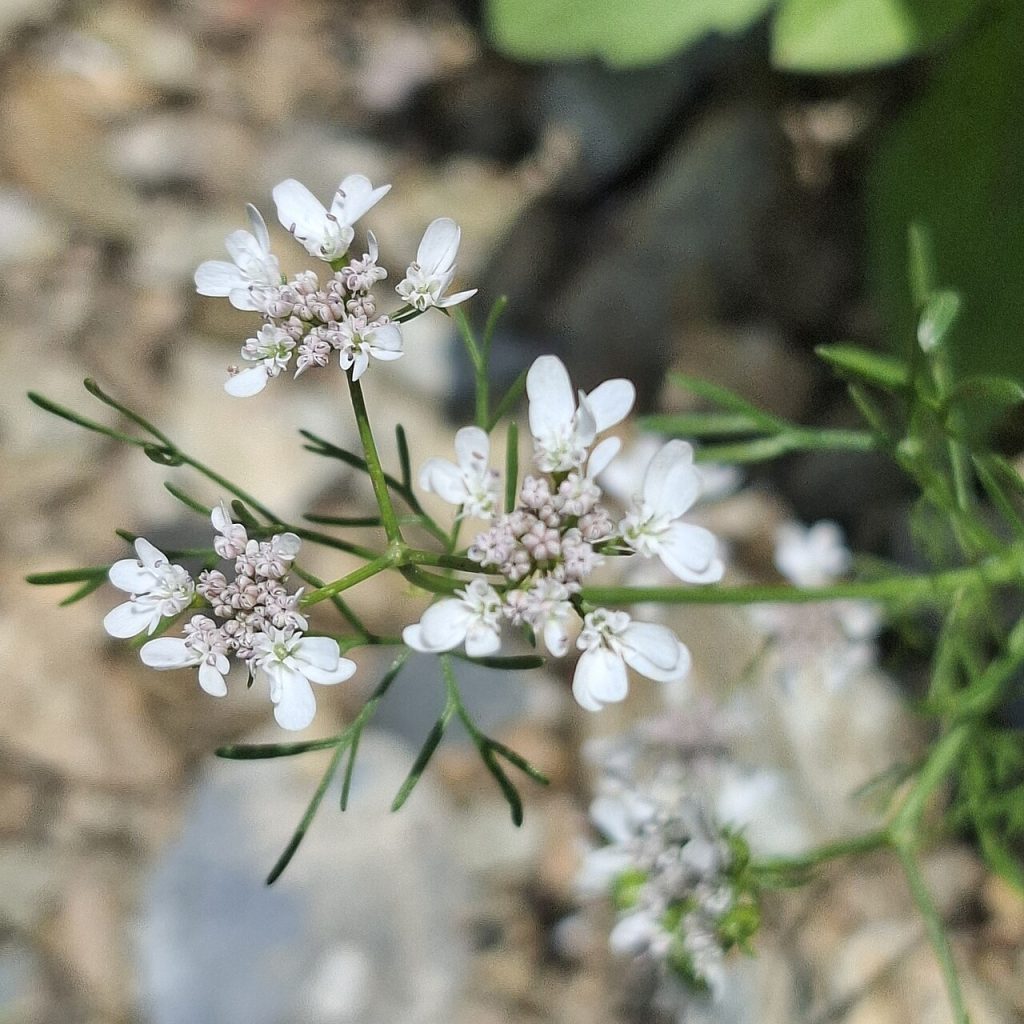
According to Do Tat Loi’s reference work on Vietnamese medicinal plants, coriander is an annual 0.35–0.5 m tall, with a smooth stem branching near the top. The lower leaves are broad; the upper leaves are finely divided.
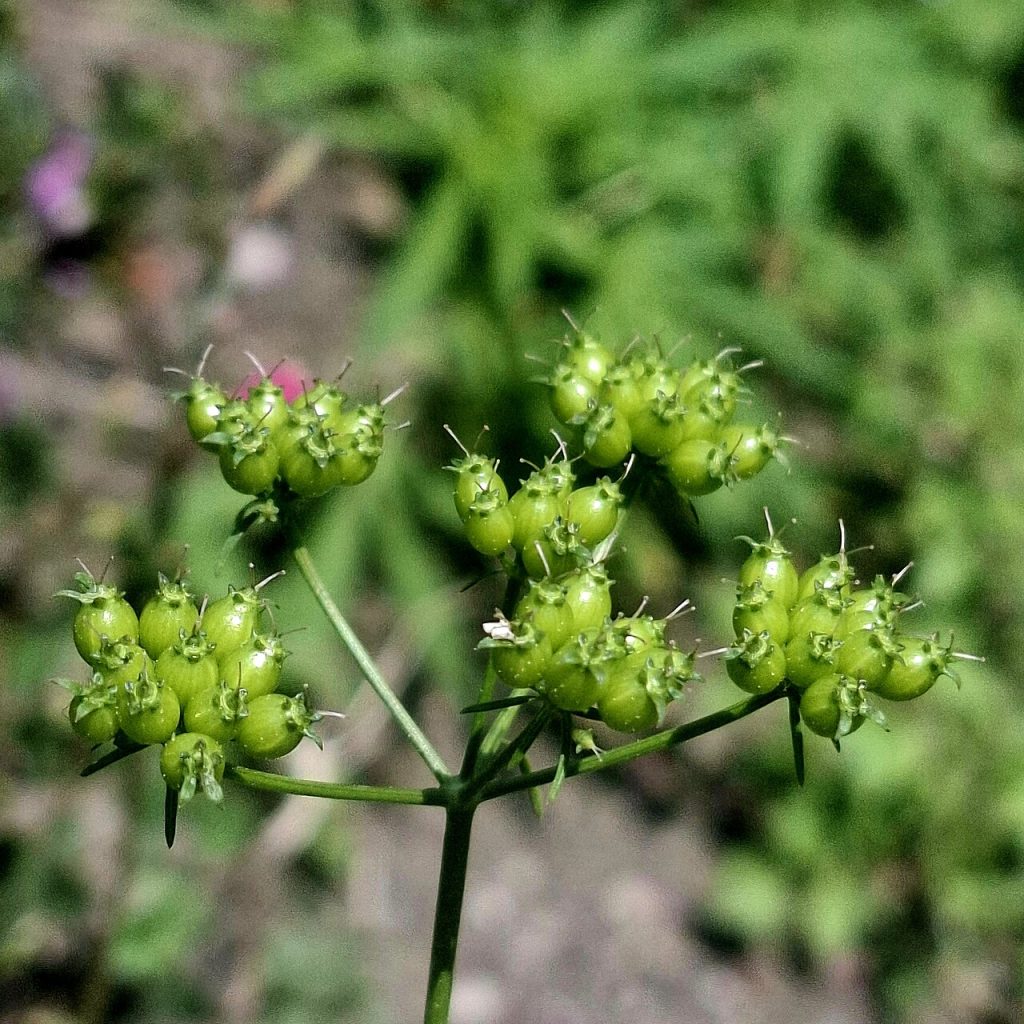
The small white or pale pink flowers grow in umbels. The small round fruits smell fragrant when ripe and dry.
Coriander is grown throughout Vietnam, mostly for its leaves. Mature coriander for Tet is usually sown at the end of the 9th lunar month (around October). After about three months, the plants flower and fruit just in time for Tet.
In Hanoi, Hoach An village (Kim An commune, former Thanh Oai district) has grown mature coriander for more than 30 years, with only one crop a year. In Co Giang hamlet (Le Chi commune, former Gia Lam district), one household has sown mature coriander in the 9th lunar month for about 20 years.
Mature coriander and the New Year’s Eve bath
On the afternoon of the last day of the lunar year, many northern Vietnamese families boil a large pot of mature coriander so everyone can take a year-end bath. Folk belief holds that the bath washes away the dust, bad luck and worries of the old year. The family then enters the new year clean and fortunate.
The traditional method is simple. The plants are rinsed of soil without crushing the leaves, dropped into boiling water, and then mixed with cool water until comfortably warm. Some families add clove basil, lemongrass or pomelo peel.
In Hoach An, the main harvest lasts only a few days, from about the 25th to the 30th of the last lunar month. Mature coriander oil keeps that Tet scent available even when fresh bunches are not at hand.
Uses
Traditional use
According to Do Tat Loi, traditional Vietnamese medicine describes coriander as pungent and warming. It is said to disperse, bring out measles rashes, expel “evil qi” and loosen phlegm. The fruit, leaves and roots are used:
- to aid digestion, strengthen the stomach and relieve wind in the lower abdomen;
- to help measles and pox rashes come out (folk practice);
- boiled as fragrant bath water, especially at Tet.
What research says
- Antibacterial: a 2011 study found that coriander oil killed many kinds of bacteria in laboratory tests, mainly by damaging the bacterial cell membrane.
- Composition by plant part: fresh coriander leaf oil is dominated by aldehydes such as (E)-2-decenal and decanal, with very little linalool. Coriander seed is rich in linalool.
For information only; not a substitute for medical advice.
Industrial applications
| Industry | Applications |
|---|---|
| Household | Room diffusing, scented candles and wax melts for Tet |
| Cosmetics | Soap, shower gel and shampoo with a mature-coriander scent |
| Spa | Foot soaks, herbal steam |
| Flavours | Coriander note for seasonings and dipping sauces (lots that meet the standard) |
Scent profile and blending
Mature coriander combines the green, slightly sharp note of the leaves with the sweet warmth of the seeds. Diluted, it smells very much of Tet, like the steam from the year-end bath.
- Blend with clove basil for the classic Tet bath-water scent.
- Blend with pomelo peel and Java citronella for a fresh, bright scent.
- Blend with cassia bark and star anise (at very low levels) for candles and room scent in cold weather.
How to use at home
- Room diffusing: 3–4 drops in a diffuser, especially in the living room at Tet.
- Year-end bath: mix 5–6 drops with a spoon of salt or shower gel, then add to a basin of warm water; stir well before use.
- Foot soak: 2–3 drops with a spoon of salt in a basin of warm water.
- Handmade soap and candles: usually 1–3% of the formula.
DIY mature coriander bath
Mix 10 ml unscented shower gel with 4 drops of mature coriander and 2 drops of clove basil. Pour into a basin of about 10 litres of warm water and stir well. Do not drop the oil straight into water: it floats as droplets and can sting the skin.
Safe use
- Dilute to 1–2% for skin use (2–4 drops in 10 ml carrier oil); patch-test on the wrist first.
- Linalool oxidises over time and can then cause skin allergy. Do not apply oil whose scent has changed.
- Do not use for children under 2. Pregnant and breastfeeding women should ask a doctor first.
- Do not swallow; avoid the eyes. If swallowed, do not induce vomiting; call 115 (Vietnam emergency) or go to a medical facility.
- Keep away from children and pets. Do not diffuse in a closed room with a cat.
How to recognise good oil and store it
- Good oil is clear, colourless to pale yellow, with a distinct green and sweet coriander scent and no burnt note.
- Oil from plants with many seeds smells sweeter; oil from leafier plants smells greener and sharper.
- Keep tightly closed, in a cool place, and open as little as possible. Best used within 1–2 years.
Young coriander, mature coriander and coriander seed
| Criterion | Young coriander (herb) | Mature coriander | Dried coriander seed |
|---|---|---|---|
| Raw material | Young leaves and stems | Whole plant with flowers and fruit | Ripe dried fruit |
| Key scent compounds | Aldehydes (decenal, decanal) | Aldehydes + linalool | Linalool |
| Scent | Green, sharp | Green, warm, sweet | Sweet, slightly floral, woody |
| Oil content | Very low | In between | 0.3–1% (Do Tat Loi) |
Why does the plant have to be “mature”?
Young coriander leaves contain very little oil. A 2022 study obtained only about 0.03–0.04% oil from fresh coriander leaves. Do Tat Loi, by contrast, records 0.3–0.8% oil in coriander fruit, sometimes up to 1%.
So plants left to mature until they set seed give more oil than young plants. The oil also gains linalool from the seeds, adding a sweet warmth that young coriander lacks.
Quality specifications
The main parameter is the chromatogram: linalool and the aldehyde group (decanal, decenal, dodecenal), together with relative density and refractive index. The balance between the two groups depends on how much seed the plants carry at distillation. Every lot comes with a COA and MSDS.
Reference figures; actual values follow the COA of each lot.
Why source mature coriander oil from Vietnam?
Growing coriander to maturity for Tet is a living tradition in northern Vietnam. Villages on the edge of Hanoi sow a winter crop every year so that plants flower and fruit just before the New Year.
This oil captures a scent that is specific to Vietnamese culture, not just a generic coriander note. For brands making Tet gift sets, bath products or candles, it carries a story customers already recognise.
What buyers usually ask for
Cosmetic brands, candle makers and distributors typically ask for:
- COA (certificate of analysis) for the lot.
- GC-MS or GC chromatogram showing linalool and the aldehyde group.
- MSDS / SDS for handling and transport.
- A sample before contract, to check the scent in their own base.
- Season planning, since raw material follows the winter crop that is harvested just before Tet.
If you need mature coriander oil for a Tet product line, contact us well before the season to discuss volumes and documents.
Growers & cooperatives
The company buys whole mature coriander plants that have flowered and set seed. The buying season runs from October to Tet, following the winter sowing calendar. Priority areas:
- Hanoi: Hoach An village (former Thanh Oai district), Co Giang (former Gia Lam district) and other winter-crop mature coriander areas.
- Other winter coriander areas in the Red River Delta: send a sample first so we can test the oil.
Raw material requirements:
- Plants must carry fruit; the more fruit, the better. Fresh or lightly wilted; not waterlogged or mouldy.
- Shake off soil and trim most of the roots; no weeds or other vegetables.
- If pesticides were used, the pre-harvest interval must be respected and the company must be told.
- We also accept mature coriander left over after the Tet markets, as long as it has not rotted.
Oil content depends on how much fruit the plants carry; Do Tat Loi records 0.3–1% oil in coriander fruit. Growers should contact us before sowing to agree on volumes. To talk about selling mature coriander, call or message on Zalo: +84 983 299 529. See more on the Raw material sourcing page.
Extraction process
- Receive the mature plants; remove roots, soil and rotten plants.
- Cut into lengths and load the still.
- Steam-distil and separate the oil layer.
- Settle, filter and remove water.
- Test linalool and the aldehyde group; keep the COA under the lot code.
Frequently asked questions
Does mature coriander oil smell like the Tet bath?
Very close, because it is distilled from the same seeding plants. Diluted in warm water, it gives the familiar scent of New Year’s Eve afternoon.
Is mature coriander the same as culantro (ngò gai)?
No, they are different species. Culantro is Eryngium foetidum; mature coriander is ordinary Coriandrum sativum left to grow old.
Can I drop the oil straight into the bath?
Better not. Mix it first with salt, shower gel or a carrier oil so it disperses evenly.
Can children bathe in water with mature coriander oil?
Not under 2 years old. For older children, use only 1–2 drops mixed with shower gel in a large basin.
Why not distil young coriander?
Young leaves contain very little oil and lack the linalool from the seeds, so the scent is less warm.
Can mature coriander oil be used in cooking?
Only in industrial food production, with lots that meet the standard. Do not add it to food yourself at home.
I grow mature coriander for Tet. Can I sell to the company?
Yes. Contact us before sowing or as soon as the plants set seed, with your area and expected harvest date.
When should buyers order for Tet products?
Before the winter crop is sown, since raw material is only available in the weeks before Tet.
Read more: Mugwort oil Clove basil oil Thai basil oil Vietnamese herbal essential oils
Supplying mature coriander raw material, or interested in contract growing?
Thảo Dược Xanh buys raw materials and provides technical support to farmers and cooperatives in Vietnam.
References: Coriander – Do Tat Loi, Medicinal Plants of Vietnam · Remembering the scent of mui gia on Tet eve (Vietnam Financial Times) · Mui gia draws Tet shoppers (VnBusiness)