Thai basil oil is steam-distilled from Ocimum basilicum grown in Vietnam. Unlike European basil, which is rich in linalool, Vietnamese basil contains about 74–92% methyl chavicol (estragole). It smells sweet and herbal, with a hint of anise.
Basil is a Vietnamese folk remedy for colds and bloating. The oil is also used to repel mosquitoes, scent rooms and create flavour and fragrance blends.
Quick facts
- Scientific name
- Ocimum basilicum L.
- Trade name
- Basil oil, methyl chavicol type (Vietnam)
- Part used
- Above-ground parts, cut at flowering
- Method
- Steam distillation
- Appearance and odour
- Colourless to pale yellow; sweet basil scent, slightly anise-like
- Main components
- Methyl chavicol (estragole) about 74–92%; linalool (minor), 1,8-cineole
- Storage
- Dark glass bottle, tightly closed, in a cool place
What is Thai basil oil?
Thai basil (húng quế, also called rau quế) is a familiar herb in Vietnam. It is served fresh with pho, rice-noodle dishes and salads.
The above-ground parts of the plant are steam-distilled when it flowers. This gives a colourless to pale yellow oil. It smells sweet and herbal, with a clear anise note, much like crushed basil leaves.
The same species, Ocimum basilicum, has several chemical types. Italian sweet basil, used for pesto, is rich in linalool and has a soft floral scent. Vietnamese and Thai basil are rich in methyl chavicol and smell of anise and liquorice.
For this reason, Vietnamese basil oil is sold internationally as “basil oil, methyl chavicol type”.
What does the plant look like, and where is it grown?
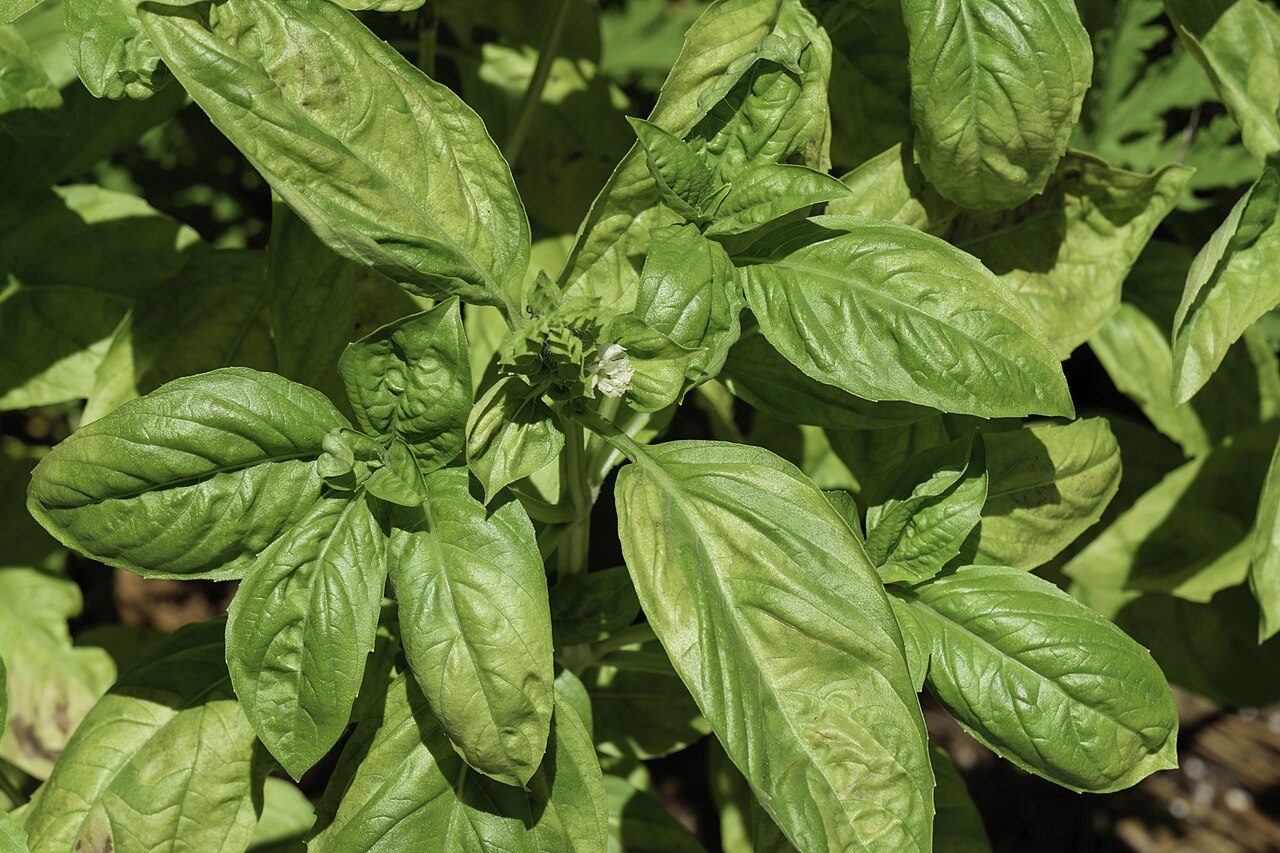
Thai basil is a herb 40–80 cm tall. Its square stem is often purple, and its glossy green leaves have slightly toothed edges. Small purple or white flowers grow in spikes at the tips.
The plant likes sun, heat and loose, well-drained soil. It is grown from seed or cuttings and can be harvested after a few months.
Basil is grown all over Vietnam, from home gardens to specialised vegetable areas. Research samples of the oil have been collected in Thai Nguyen, Thanh Hoa and Dak Lak. In hot regions, the plant gives 3–5 harvests a year.
Basil in Vietnamese daily life
Basil is part of the fresh herb plate served with many noodle soups in southern Vietnam. It also appears in bowls of pho in the north. Basil seeds (hạt é) are soaked until they swell and used in cool summer drinks.
In folk practice, basil leaves are boiled for steam inhalation during a cold. Crushed leaves are applied to insect bites. Many families keep a pot of basil on the windowsill to keep away mosquitoes and flies.
Uses
Traditional use
In traditional Vietnamese medicine, basil is described as pungent and warm in nature. Traditional medicine and folk practice use it to:
- relieve colds and flu, headaches and mild fever;
- relieve stomach aches, bloating and indigestion;
- apply crushed leaves to insect stings to ease itching.
What research says: antibacterial and mosquito repellent
- Antibacterial activity: in laboratory tests, basil oil inhibits many bacteria and fungi.
- Mosquito repellent: in trials, basil oil repels mosquitoes and kills mosquito larvae. It is often blended with Java citronella oil.
For information only; not a substitute for medical advice.
What is methyl chavicol (estragole)?
Methyl chavicol, also called estragole, is the main aroma compound in Vietnamese basil and in tarragon. Star anise and fennel also contain small amounts. It gives a sweet anise–liquorice scent and is used in food flavourings and oral-care products.
At very high, long-term doses, estragole caused liver cancer in laboratory mice. For this reason, the EU and some other markets limit estragole in food.
For home users, do not drink basil oil or add it to food yourself. Do not use it on skin or for massage either. The suitable uses are diffusing, floor cleaning and room sprays to repel mosquitoes.
Industrial applications
| Sector | Applications |
|---|---|
| Flavours and fragrances | Herbal notes (within each market’s limits) |
| Oral care | Flavour blends for toothpaste and mouthwash |
| Household | Room scents, scented candles, mosquito-repellent products |
Industrial buyers who use this oil in flavours or oral care must follow the estragole limits of their own market. The COA helps them calculate how much they can use.
Scent profile and blending
Vietnamese basil smells sweet, herbal, lightly anise-like and fresh. It recalls fresh herbs and Vietnamese cooking.
- Blend with Java citronella for mosquito-repellent blends.
- Blend with lime and litsea cubeba for a fresh room scent.
- Blend with cornmint for a clean, fresh kitchen-floor wash.

How to use at home
- Repel mosquitoes indoors: add 2 drops of basil and 3 drops of Java citronella to a diffuser. Run it for 30–45 minutes in the early evening, pause, and run again when needed.
- Room scent: 2–3 drops, blended with lime and cornmint.
- Kitchen floor wash: 5–10 drops in a bucket of water.
DIY “fresh herb” mosquito-repellent spray
Mix 100 ml of distilled water, 10 ml of 70% alcohol, 8 drops of basil, 8 drops of Java citronella and 4 drops of litsea cubeba. Shake well before each use. Spray on curtains, under tables and in room corners in the early evening.
Do not spray directly on skin or face, and do not spray on food. Use up within 1–2 weeks and keep in a cool place.
Safe use
- Do not apply basil oil to skin or use it for massage. Use it only for diffusing, cleaning and room sprays.
- Do not drink it or add it to food yourself. If swallowed, seek medical care.
- Not for use during pregnancy or breastfeeding, or around young children; avoid the eyes.
- Do not diffuse at high strength near dogs or cats. Keep bottles out of reach of children and pets.
How to recognise good oil and store it
- Good oil is colourless to pale yellow, with a sweet basil scent and a clear anise note.
- Basil oil with a soft floral scent and little anise is the linalool type, a different oil. The COA states the chemical type.
- Keep tightly closed and away from sunlight. Best used within 1–2 years.
Vietnamese basil vs Italian sweet basil
| Criterion | Vietnamese basil | Italian sweet basil |
|---|---|---|
| Main component | Methyl chavicol | Linalool |
| Scent | Sweet, anise, liquorice | Floral, soft, slightly clove-like |
| Culinary use | Fresh herbs, pho, noodle dishes | Pesto, pizza |
| Oil name on the market | Basil oil, methyl chavicol type | Sweet basil oil, linalool type |
When buyers ask for “basil oil”, it is worth confirming which type they mean. The two oils are not interchangeable in fragrance or flavour work.
Quality parameters
The main quality parameter is methyl chavicol. Vietnamese samples have recorded from about 74% (Dak Lak) to 92% (Thanh Hoa). The classic Vietnamese reference by Do Tat Loi states that the plant contains about 0.4–0.8% essential oil.
Every batch comes with a COA stating the chemical type, plus an MSDS.
Reference figures only; actual specifications follow the COA of each batch.
Why source basil oil from Vietnam?
Basil is grown everywhere in Vietnam and is a part of daily life. Farmers already know how to grow it, and the plant turns over quickly. In hot regions, it gives 3–5 harvests a year.
Vietnamese basil belongs to the methyl chavicol type. Published samples show a high methyl chavicol content. This suits buyers who want a clear, sweet, anise-like basil note.
We work with households and cooperatives that grow basil specifically for distillation. Harvesting at full flowering, rather than as a young vegetable, is the key difference.
What buyers usually ask for
Buyers of basil oil usually ask for:
- COA (certificate of analysis) that states the chemical type and the methyl chavicol content.
- GC-MS chromatogram, to check methyl chavicol, linalool and 1,8-cineole.
- MSDS (safety data sheet) for handling, storage and transport.
- A sample before contract, to test the scent and check the profile against their own specifications.
Flavour and oral-care buyers also check the estragole level against the rules of their market. The COA for each batch supports this check.
Growers & cooperatives
Basil is widely grown (Thai Nguyen, Thanh Hoa, Dak Lak and more) and turns over quickly. The company works with households and cooperatives that grow basil specifically for distillation.
- Cut the plants at full flowering, when the oil content is highest. This is different from cutting young leaves to sell as a vegetable.
- 3–5 harvests a year in hot regions; wilt the plants for 1–2 days before delivery.
- No weeds mixed in, and no pesticide spraying before harvest.
- We provide free planting stock and technical support, and sign purchase contracts.
To join, call or message us on Zalo at +84 983 299 529. See more on the Raw material sourcing page.
Growing basil as a vegetable vs for oil
| Criterion | Grown as a vegetable | Grown for oil |
|---|---|---|
| When to cut | Young leaves, before flowering | At full flowering |
| Planting density | Dense, with tips cut constantly | Wider, so plants branch and flower |
| How it is sold | Fresh bunches, sold daily at market | Whole plants, wilted, sold by the tonne |
| Advantage | Priced per bunch, quick turnover | Less dependent on market prices, with a purchase contract |
Vegetable growers can set aside part of their land to grow basil for oil. This gives them an extra, stable outlet, especially when vegetable prices fall. The plant residue after distillation can be composted and returned to the field as fertiliser.
Extraction process
- Cut the plants at full flowering and wilt them for 1–2 days.
- Steam-distil and separate the oil layer.
- Filter and remove water.
- Test for methyl chavicol and keep the COA under its batch code.
Frequently asked questions
Why does Vietnamese basil smell different from Italian basil?
They are two different chemical types. Vietnamese basil is rich in methyl chavicol, so it smells of anise. Italian basil is rich in linalool, so it smells more floral.
Does basil oil repel mosquitoes?
In trials, basil oil repels mosquitoes. Blending it with Java citronella gives a more pleasant scent. The effect is short, so diffuse again after a few hours.
What is estragole?
Another name for methyl chavicol, the main aroma compound of basil and tarragon. Some countries limit it in food.
Can basil seeds be distilled for oil?
No. Basil seeds are used for drinks. The oil is distilled from the stems, leaves and flowers.
Does a pot of basil keep mosquitoes away?
The scent of the leaves may make mosquitoes and flies less likely to come near the window. The effect is much weaker than the essential oil.
Can basil oil be used around pets?
Do not diffuse essential oils at high strength near dogs or cats. Many essential oils cause discomfort or are toxic to pets, especially cats.
Can I use basil oil on my skin?
No. We recommend basil oil only for diffusing, cleaning and room sprays, not for skin or massage.
I grow basil as a vegetable. Will the company buy it?
Yes, if the plants are in flower and there is enough volume for one collection trip.
Read more: Clove basil oil Java citronella oil Litsea cubeba oil Vietnamese herbal essential oils
Supplying thai basil raw material, or interested in contract growing?
Thảo Dược Xanh buys raw materials and provides technical support to farmers and cooperatives in Vietnam.
References: Basil – Do Tat Loi · PROSEA – Ocimum basilicum