Cornmint oil is steam-distilled from the leaves and stems of Mentha arvensis, using the SW88 Japanese mint variety. Its main compound is menthol, which gives a strong, cool, minty scent.
In traditional Vietnamese medicine, mint is a familiar remedy for colds, headaches and a blocked nose. The oil is also widely used in flavours, cosmetics and for extracting menthol crystals. Thảo Dược Xanh (Blue Herbs) grows and distils it in Lac Luong, Phu Tho.
Quick facts
- Scientific name
- Mentha arvensis L. (SW88 variety)
- Trade names
- Cornmint oil, Japanese mint oil
- Part used
- Leaves and stems, cut when the plant flowers
- Method
- Steam distillation
- Appearance
- Colourless to pale yellow; sharp, cool scent; menthol may crystallise in the cold
- Main compounds
- Menthol 55–80% depending on variety and cut; menthone, isomenthone
- Storage
- Dark glass bottle, tightly closed, in a cool place
What is cornmint oil?
Cornmint (bạc hà á), also called Japanese mint, is the richest in menthol of the commonly grown mints. Steam-distilling its leaves and stems gives a clear liquid with a sharp, cool smell. That liquid is cornmint oil.
At low temperatures, the menthol in the oil can form white crystals. This is a sign of a menthol-rich oil, not a sign that the oil has gone bad.
Cornmint is different from peppermint (Mentha × piperita). Peppermint smells rounder and sweeter and contains less menthol. Cornmint is cooler and sharper, and it is the world’s main source for producing menthol crystals.
The SW88 variety grown by Thảo Dược Xanh belongs to the cornmint group. It was chosen because it gives plenty of leaf and a high oil content.
What does the cornmint plant look like, and where does it grow?
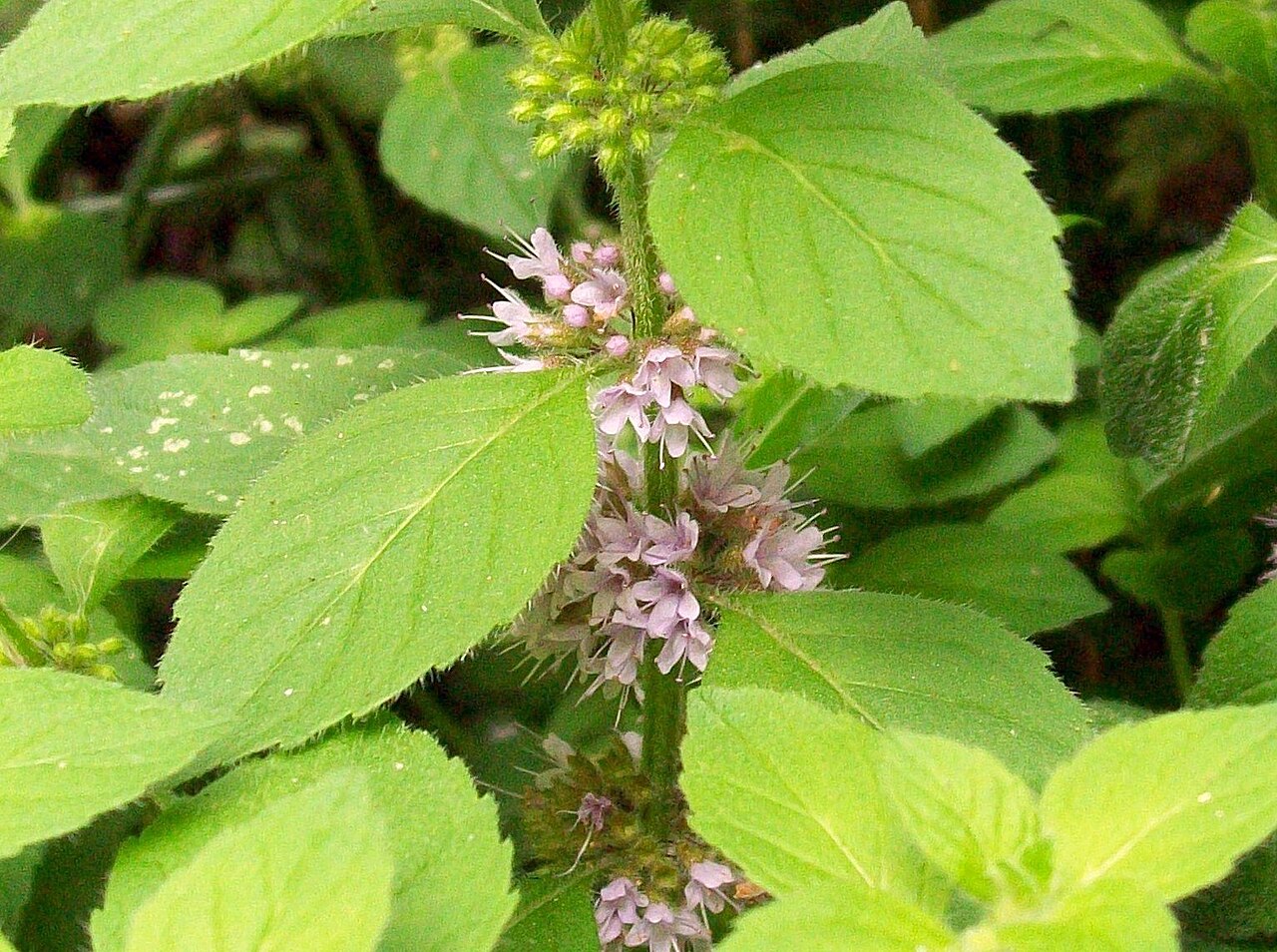
Cornmint is a perennial herb, 30–60 cm tall, with a square stem and opposite, toothed leaves. Small pale purple flowers grow in rings where the leaves meet the stem. The plant spreads quickly by underground runners, so one planting can be cut many times.
In Vietnam, mint was once grown as a crop in Nghia Trai (Hung Yen) and around Hanoi. It also grows wild in some cool mountain areas such as Sa Pa and Tam Dao.
Mint likes loamy soil rich in humus, moist but well drained, and a cool climate. The leaves hold the most oil when the plant starts to flower and the weather is sunny and dry.
Scent and blending
Cornmint oil smells cold, minty and clean, and it evaporates quickly. In perfumery it is a top note. Because the scent is so strong, only a small amount is needed.
- Blend with Java citronella, lemon or litsea for a fresh scent, good for diffusing in the daytime.
- Blend with cassia or ginger for a warm-and-cool feel, good for rubs.
- Blend with white champaca leaf or patchouli to soften the sharpness in oil-based perfumes.
How to spot good oil and how to store it
- Good oil is clear, not cloudy at room temperature. It smells cool and clean, with no stale-grass or kerosene notes.
- Put a drop on white paper: pure oil evaporates almost completely within a few hours and leaves no greasy ring. This is only a rough test; to be sure, check the chromatography results on the COA.
- Store in dark glass, tightly closed and away from sunlight. The oil keeps its quality for about 2–3 years. Oil that is kept too long or opened often will lose scent and turn yellow.
Uses
Traditional use
In traditional Vietnamese medicine, mint is described as pungent and cooling, acting on the lung and liver meridians. It is traditionally used to:
- relieve colds and fever, headache, blocked nose and sore throat;
- help digestion when the stomach feels bloated or heavy;
- cool the skin and ease itching.
Mint and menthol are found in many of the medicated oils and balms that are familiar in Vietnam.
What research says
- Cooling and local pain relief: menthol activates the skin’s cold receptors. This creates a cooling feeling and mild pain relief where it is applied.
- Tension headache: some trials suggest that diluted mint oil applied to the temples helps relieve tension headaches.
- A feeling of clear breathing: inhaling menthol makes the nose feel clearer and more comfortable when blocked, even though it does not actually increase airflow.
- Mild antimicrobial action: in laboratory tests, mint oil inhibits some bacteria and fungi. This is one reason it is used in oral-care products.
For information only; not a substitute for medical advice.
Applications by industry
| Industry | Applications |
|---|---|
| Pharmaceuticals, balms | Medicated oils, balms, cooling patches |
| Flavours | Sweets, chewing gum, drinks, toothpaste |
| Cosmetics | Shampoo, shower gel, cooling creams |
| Household | Floor cleaners, room diffusing, scent sachets |
| Raw material | Menthol crystal extraction; dementholised mint oil (DMO) |
Why source cornmint oil from Vietnam?
Cornmint is grown in several countries, and India is the largest producer today. Vietnam is a small origin by volume. Its value for buyers lies in traceability rather than scale.
- Known farm and variety: the oil on this page comes from one named variety, SW88, grown at the company’s own farm.
- Grower contracts: raw material comes from the company farm and from households and cooperatives under purchase contracts.
- Batch testing: each batch is tested and its COA is kept on file under a batch code.
- Closed chain: growing, distillation and testing are linked, so a buyer can trace a batch back to its area and harvest.
For buyers who need a second origin next to a larger one, or who want a short, documented chain, this can be a useful option.

How to use at home
- Steam inhalation for a blocked nose (adults): add 2–3 drops to a bowl of hot water, cover your head with a towel and breathe for 5 minutes with your eyes closed. Do not use this method for children.
- Temples and back of the neck: mix 1–2 drops with 5 ml carrier oil (coconut, almond) and rub in gently.
- Room diffusing: 3–4 drops in a diffuser; blends well with citronella and lemon.
- Floor cleaning: 10–15 drops in a bucket of mopping water.
Suggested dilution table
| Purpose | Essential oil | Carrier |
|---|---|---|
| Small areas (temples, back of neck) | 1–2 drops | 5 ml |
| Shoulder and back massage | 3–4 drops | 10 ml |
| Foot soak | 2–3 drops | mixed into 1 spoon of salt |
Safe use
- Do not apply undiluted to skin.
- Do not use on children under 6, especially near the nose and face. Menthol can cause throat spasm and breathing difficulty in young children.
- Newborns with G6PD deficiency must avoid menthol completely.
- Pregnant or breastfeeding women should ask a doctor before use.
- Keep away from the eyes; if oil gets in the eyes, rinse with plenty of clean water.
- Do not swallow. If swallowed, do not try to induce vomiting; call emergency services (115 in Vietnam) or go to a medical facility, taking the bottle with you.
- Keep out of reach of children and pets; do not diffuse in a closed room with cats.
- People with sensitive skin should patch test one diluted drop on the wrist and wait 24 hours.
From mint leaves to menthol crystals
Most of the world’s cornmint oil is not used directly. Instead, it is chilled to separate the menthol. As the crude oil cools, menthol crystallises into a white mass. The crystals are filtered off, washed and recrystallised into pure menthol for medicines, sweets and toothpaste.
The oil left after separation is called dementholised mint oil (DMO). It still contains a fair amount of menthol and has a softer scent. It is often used in flavours and cosmetics.
So one mint field can yield three product lines: crude oil, menthol crystals and DMO.
Natural menthol from cornmint competes with synthetic menthol on the world market. Some buyers prefer the natural form for labelling or customer reasons. Others choose by price and consistency. Knowing which form a buyer needs helps decide whether crude oil, crystals or DMO is the right offer.
Quality specifications
The most important specification for cornmint oil is menthol content. Crude oil usually reaches 55–80% depending on variety, cut and distillation. For partly dementholised oil (DMO), ISO 9776 can be used as a reference.
Each batch comes with a COA showing menthol, relative density and refractive index, plus an MSDS. The most reliable way to know whether an oil has been blended is to check the chromatography results on the COA.
Reference figures; actual specifications are given on each batch’s COA.
What buyers usually ask for
International buyers tend to check the same points before they place a first order:
- Menthol content on the COA, with relative density and refractive index.
- A GC or GC-MS chromatogram showing the full profile, including menthone and isomenthone.
- Product form: crude cornmint oil, menthol crystals or DMO, and which reference standard applies.
- MSDS (SDS) for shipping and safe handling.
- A sample before contract, to test in their own lab or product. Contact the company to discuss sample needs.
- Intended use: flavour, oral care, cosmetic, balm or household. Each use has its own rules in the buyer’s market.
- Traceability: variety, farm and harvest. Batch codes on the COA link back to the growing area.
Growers & cooperatives
The company buys fresh or lightly wilted mint, cut when about 70% of the plants are flowering. Priority areas:
- Phu Tho: Lac Luong commune (formerly Hoa Binh province), home of the company’s SW88 farm.
- Tuyen Quang: Yen Minh and Quan Ba (formerly Ha Giang province), where the company has a trial plot.
- Other places with loamy, humus-rich soil and a reliable water supply can also grow it.
Support for growers:
- Free SW88 planting material, growing guidance and help with organic composting.
- 3–4 cuts per year; rotate the field after 2 years, because yields fall sharply when mint is grown in the same place without a break.
- Purchase contracts signed with each household or cooperative.
The company also commits to sustainable sourcing across all its raw materials. It does not buy material from forest clearing or from special-use (protected) forests.
To start, call or message on Zalo: +84 983 299 529. More details are on the Raw material sourcing page.
Extraction process
- Cut the plants at flowering and wilt them for 1–2 days to reduce moisture.
- Steam-distil, condense and separate the oil layer.
- Settle, filter and remove water.
- Test the oil and file the COA under the batch code.
Frequently asked questions
How is cornmint different from peppermint?
Cornmint has more menthol, so it is cooler and sharper; peppermint smells rounder and sweeter and is usually more expensive.
Does mint oil help with headaches?
Many people feel better after rubbing diluted mint oil on their temples. A headache that lasts needs a doctor’s check.
Why does the oil go solid in cold weather?
Menthol crystallises at low temperatures. Stand the bottle in warm water and it melts again, with no effect on quality.
Can mint oil be used on children?
Do not use it on children under 6, especially near the nose and face.
Does mint oil keep away mice and ants?
The strong scent bothers ants and mice, and they often avoid places that smell of it. The effect is short, so it needs topping up often, and the house should be kept clean.
How much oil does a mint crop give?
Fresh plants give about 0.7–0.8% oil, meaning about 7–8 kg of oil per tonne of fresh plants, depending on variety and cutting time.
What is DMO?
DMO is dementholised mint oil: the oil left after menthol crystals have been separated. It is softer in scent and is used in flavours and cosmetics.
Is Vietnamese cornmint oil the same as Indian cornmint oil?
Both come from Mentha arvensis, but variety, soil, climate and distillation change the profile. Compare the COA and chromatogram of each batch rather than relying on origin alone.
I want to grow mint and sell it to the company. How do I start?
Call or message on Zalo: +84 983 299 529. The company will survey your land, supply planting material and sign a purchase contract.
Read more: The mint plant SW88 mint variety How mint oil is made Mint safety notes
Supplying cornmint raw material, or interested in contract growing?
Thảo Dược Xanh buys raw materials and provides technical support to farmers and cooperatives in Vietnam.
References: Bạc hà – Những cây thuốc và vị thuốc Việt Nam (Đỗ Tất Lợi)