Tea tree oil (tràm trà) is steam-distilled from the leaves and terminal branchlets of Melaleuca alternifolia, a plant native to Australia. Its main component is terpinen-4-ol, at about 35–48% under the ISO 4730 standard.
Tea tree is not the same as Vietnam’s native cajuput tree or as niaouli. Tea tree oil is low in cineole and has a medicinal, fresh-woody scent. It is used mainly in skin care and cleaning products.
Quick facts
- Scientific name
- Melaleuca alternifolia (Maiden & Betche) Cheel
- Trade name
- Tea tree oil, Melaleuca oil (terpinen-4-ol type)
- Part used
- Leaves and terminal branchlets
- Method
- Steam distillation
- Appearance and odour
- Colourless to pale yellow; medicinal, fresh-woody, slightly spicy
- Main components
- Terpinen-4-ol 35–48%; γ-terpinene 14–28%; α-terpinene 6–12%; low 1,8-cineole (≤10%)
- Storage
- Dark glass bottle, tightly closed, in a cool place away from light
What is tea tree oil?
Tea tree is a shrub of the myrtle family (Myrtaceae). It belongs to the same genus, Melaleuca, as the familiar cajuput trees of Vietnam.
The name “tea tree” may come from Captain James Cook’s description of a shrub whose leaves were used to make a drink in place of tea. The oil is obtained by steam-distilling the leaves and young branchlets.
The oil is colourless to pale yellow. It smells sharp and medicinal, with a fresh woody and slightly spicy note.
Commercial production of tea tree oil began in Australia in the 1920s. Today the oil is sold neat, or as an ingredient in shampoos, face washes and creams.
Tea tree, cajuput and niaouli: do not confuse them
In Vietnamese, the word “tràm” covers several species. The three most often confused are:
- Cajuput (tràm gió, tràm cừ), Melaleuca cajuputi: a native tree that grows wild across the country, most abundantly in the south. In central Vietnam it is common on low hills. The traditional cajuput oil of Hue and Quang Tri is distilled from this tree.
- Niaouli (tràm 5 gân), Melaleuca quinquenervia: an introduced tree with broad leaves that carry five parallel veins. Its oil is rich in 1,8-cineole. See niaouli oil.
- Tea tree (tràm trà), Melaleuca alternifolia: introduced from Australia, with small, narrow, soft needle-like leaves. Its oil is rich in terpinen-4-ol.
What does the tea tree look like, and where does it grow?
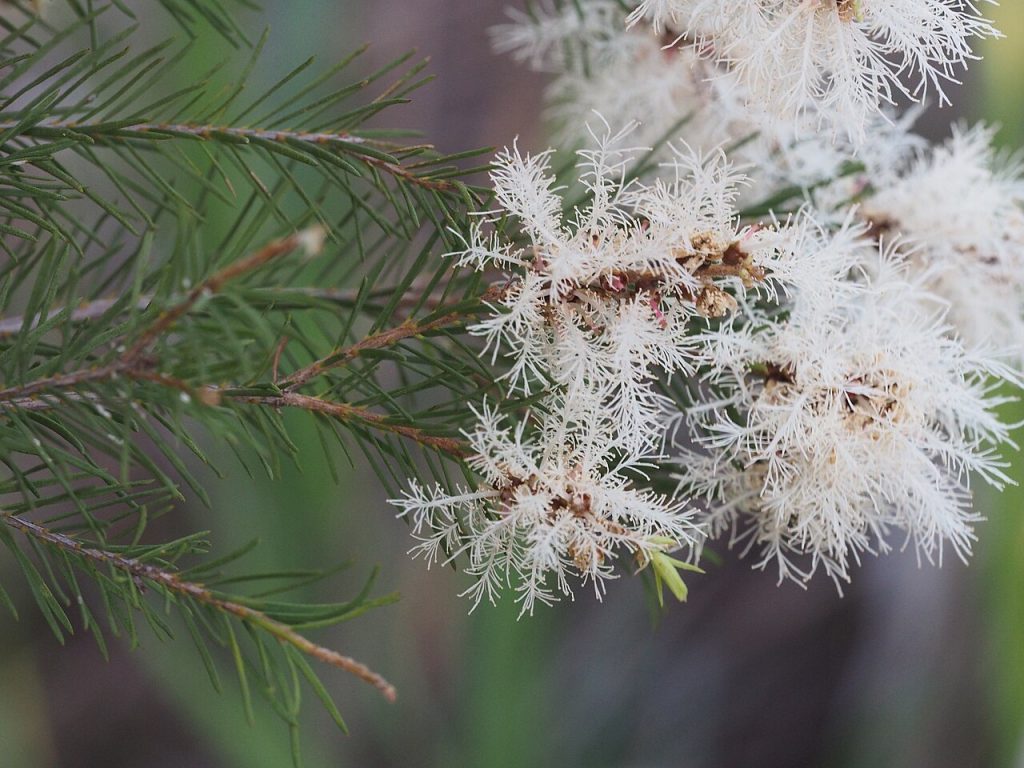
Tea tree is a shrub or small tree that can reach about 7 m. It has whitish, papery bark and narrow leaves 1–3.5 cm long and only about 1 mm wide. The white flowers form bottlebrush-like spikes.
The species is endemic to Australia. It grows naturally along streams and in swampy areas of south-east Queensland and the north coast of New South Wales. It is the main source of commercial tea tree oil.
In Vietnam, tea tree seed and clones have been imported from Australia for trials. According to Le Dinh Kha and colleagues (Vietnam Journal of Science and Technology, 2018), terpinen-4-ol-rich tea tree was trial-planted at Ba Vi (Hanoi) and Phu Loc (Hue City).
At Ba Vi, the fresh leaves of several clones gave 3.06–3.87% essential oil, with terpinen-4-ol at 40–43%.
The same study found that tea tree at Phu Loc had low survival and grew more slowly than at Ba Vi. In other words, not every site is suitable, and variety and site must be chosen with care.
Uses
Traditional use
Tea tree is an introduced plant, so it does not appear in Vietnamese traditional medicine texts. Do Tat Loi’s reference work on Vietnamese medicinal plants describes only the native cajuput tree. Its leaves and oil are used for coughs and colds, for steam inhalation, and for massage when the body aches.
What research says
- Antibacterial and antifungal: in laboratory tests, tea tree oil inhibits many bacteria, yeasts and skin fungi. Terpinen-4-ol is considered the main active compound.
- Acne: a 2015 Cochrane review found only one low-quality trial, which showed tea tree gel worked better than placebo. The evidence is still limited.
- Nail fungus and head lice: there is not enough evidence that it works. It is not recommended for treating lice in children.
For information only; not a substitute for medical advice.
Terpinen-4-ol and cineole: why they define quality
The international standard ISO 4730 calls tea tree oil “oil of Melaleuca, terpinen-4-ol type”. To comply, the oil must contain 35–48% terpinen-4-ol and no more than 10% 1,8-cineole (2017 edition). Buyers usually prefer oil high in terpinen-4-ol and low in cineole.
High cineole gives the oil a sharp, eucalyptus-like smell. Such oil no longer matches the “terpinen-4-ol type” that the market buys.
According to a study in the Journal of Medicinal Materials (Hanoi, 2003), tea tree grown from seed in Vietnam split into several chemical types. Some plants were rich in terpinen-4-ol, while others were rich in cineole or terpinolene.
For this reason, a tea tree plantation that aims for standard-grade oil should be planted from selected varieties or clones, not from seed of unknown origin.
Four myrtle-family oils compared
| Criterion | Tea tree | Cajuput | Niaouli | Eucalyptus |
|---|---|---|---|---|
| Scientific name | M. alternifolia | M. cajuputi | M. quinquenervia | Eucalyptus globulus |
| Origin | Australia; introduced | Native to Vietnam | Australia, New Caledonia; introduced | Australia; grown in many countries |
| Main components | Terpinen-4-ol 35–48% | 1,8-cineole, highly variable | 1,8-cineole; α-terpineol, viridiflorol | 1,8-cineole ≥70% (ISO 770) |
| Scent | Medicinal, fresh-woody | Sharp, warm-cool | Sharp, cool, lightly sweet | Sharp, strongly cooling |
| Mostly used for | Skin care, cleaning | Inhalation, warming rubs | Inhalation, rubs, cosmetics | Inhalation, rubs, medicated oils |
Applications by industry
| Industry | Applications |
|---|---|
| Cosmetics | Face washes, spot gels, shampoos, soaps |
| Personal hygiene | Foot deodorisers, hand washes, soaps |
| Household | Surface cleaners, deodorising sprays |
How to use at home
- Add to face wash or shampoo: 2–4 drops per 10 ml of product (about 1–2%). Shake well before use.
- Spot application on the skin (adults): mix 1 drop with 1 ml carrier oil and dab on with a cotton bud. Avoid broken skin.
- Shoe and cupboard odours: 3–5 drops on cotton or paper, placed inside shoes or in cupboard corners.
Safe use
- Always dilute before applying to skin; 1–2% is enough for regular use. Patch-test on the inner wrist for 24 hours first.
- Oil that is old or has been exposed to light and air oxidises and is more likely to cause skin allergy. If the oil smells different or has thickened, do not apply it to skin.
- Do not swallow and do not use in the mouth. Tea tree oil is toxic when swallowed. If swallowed, do not induce vomiting; call 115 (Vietnam emergency) or go to a medical facility, and take the bottle with you.
- Do not use on young children. Pregnant and breastfeeding women should ask a doctor before use.
- Especially dangerous for cats and dogs: never apply to pet fur or skin, and do not diffuse in a room with a cat.
How to recognise good oil, and how to store it
- Good oil is clear, colourless to pale yellow, with a medicinal, fresh-woody scent. It should not smell harsh like eucalyptus.
- Standard-grade oil comes with a certificate of analysis (COA) giving terpinen-4-ol and 1,8-cineole under ISO 4730.
- Keep tightly closed, in a cool place, away from sunlight, and avoid opening too often. Once opened, use within about 1 year.
Quality specifications
The key specification is the chromatographic profile under ISO 4730: terpinen-4-ol, γ-terpinene, α-terpinene, 1,8-cineole and several minor components. Every lot comes with a COA and an MSDS.
Reference figures only; actual specifications follow the COA of each lot.
Tea tree from Vietnam: what to expect
Australia is the home and the best-known origin of tea tree oil. In Vietnam, tea tree is still mostly at the trial and pilot stage, so volumes are small.
What Vietnamese trials do show is that selected Australian varieties can give oil within the terpinen-4-ol range at suitable sites. The Ba Vi trial reached 40–43% terpinen-4-ol in several clones.
The main risk is variability. Seed-grown trees can produce cineole-rich or terpinolene-rich oil instead. For buyers, this makes lot-by-lot GC analysis essential, rather than relying on origin alone.
What buyers usually ask for
Cosmetic brands, formulators and distributors usually ask for:
- COA for the specific lot, showing compliance with the ISO 4730 profile.
- GC or GC-MS chromatogram, so they can check terpinen-4-ol, 1,8-cineole and the minor components.
- MSDS / SDS for handling, transport and product safety files.
- A sample before contract, to test scent and stability in their own formula.
- Clear information on oxidation and storage, since oxidised tea tree oil is more likely to sensitise skin.
Contact us to discuss current availability and documents.
Growers & cooperatives
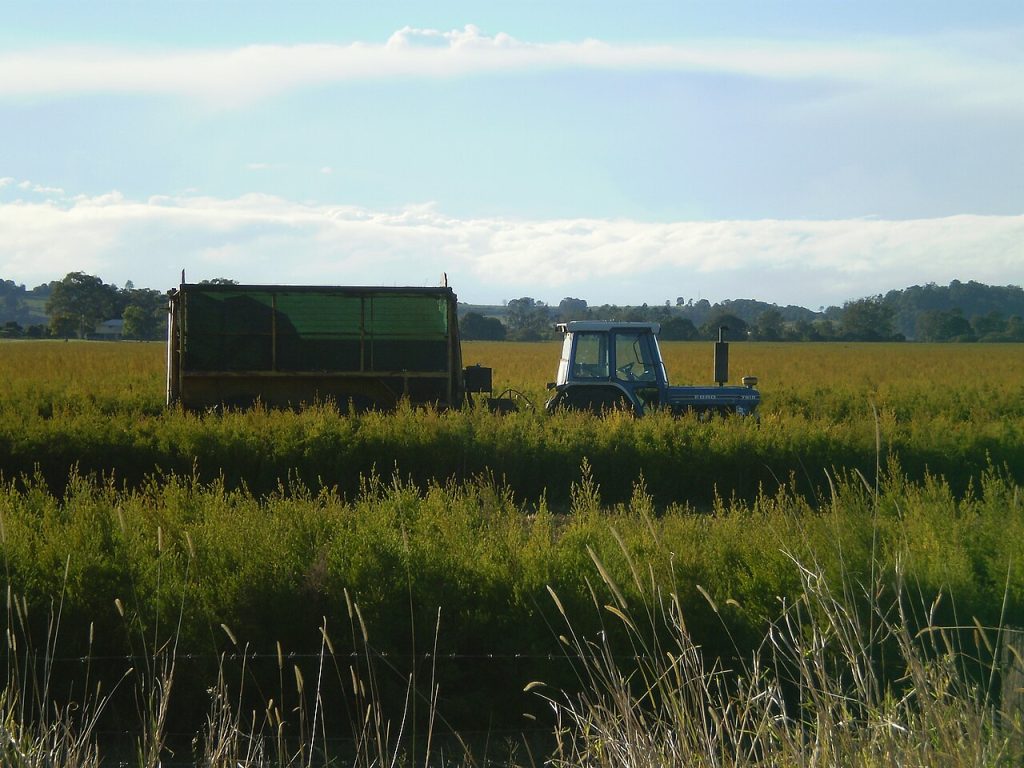
The company buys fresh tea tree leaves and young branchlets for distillation. Because tea tree in Vietnam is still mostly at trial and small pilot scale, we give priority to plantations grown from varieties of known origin.
Raw material requirements:
- Leaves and young branchlets under about 1 cm thick, fresh, free of old wood, weeds and soil.
- Cut in dry weather and delivered to the still within 1–2 days. Do not leave in heaps for long, as the material heats up and loses oil.
- The variety or clone should be known. Unselected seed-grown trees can give cineole-rich oil that does not meet the terpinen-4-ol type.
Areas of interest: trial and pilot plantings in northern and central Vietnam. Cutting time and frequency are agreed at contract, depending on tree age and site.
In the Ba Vi and Phu Loc trials, the fresh leaves of selected varieties gave about 2.6–4% essential oil. Households or cooperatives with tea tree plantations should send a leaf sample first, so the company can trial-distil it and analyse the composition.
To talk about selling tea tree leaves, call or message on Zalo: +84 983 299 529. See more on the Raw material sourcing page.
Extraction process
- Cut leaves and young branchlets and remove old wood; transport to the still within 1–2 days.
- Steam-distil and separate the oil layer.
- Settle, filter and remove water.
- Run GC analysis against ISO 4730 and keep the COA under the lot number.
Frequently asked questions
Is tea tree oil the same as Hue cajuput oil?
No. Hue cajuput oil is distilled from the native cajuput tree and is rich in cineole. Tea tree oil comes from Melaleuca alternifolia and is rich in terpinen-4-ol.
Can tea tree oil be used for inhalation or rubs on children, like cajuput oil?
It is not recommended. Tea tree oil should not be used on young children. For any child, ask a doctor before using an essential oil.
Does tea tree oil treat acne?
Some studies show positive results, but the evidence is limited. If you use it, dilute it in a face wash and stop if your skin becomes irritated.
Can I apply neat tea tree oil?
It is not recommended. Neat oil can easily irritate the skin or cause allergy, so always dilute to 1–2%.
Is tea tree grown in Vietnam?
Yes, at trial and pilot scale, for example at Ba Vi (Hanoi) and Phu Loc (Hue City). The commercial area is still small.
Why is cineole kept low in tea tree oil?
ISO 4730 limits 1,8-cineole to 10%. Higher cineole gives a eucalyptus-like smell and means the oil is not the terpinen-4-ol type buyers expect.
I have a tea tree plantation. How can I sell the leaves?
Send a leaf sample or message us on Zalo, with the area, tree age and source of planting material. The company will trial-distil it and discuss a cutting schedule.
Read more: Niaouli oil Camphor oil Cornmint oil Vietnamese herbal essential oils
Supplying tea tree raw material, or interested in contract growing?
Thảo Dược Xanh buys raw materials and provides technical support to farmers and cooperatives in Vietnam.
References: Terpinen-4-ol-rich tea tree varieties for northern Vietnam (Vietnam Journal of Science and Technology, 2018) · ISO 4730:2017 – Oil of Melaleuca, terpinen-4-ol type · Cajuput tree and cajuput oil – Do Tat Loi, Medicinal Plants of Vietnam