Niaouli oil (tràm 5 gân) is steam-distilled from the leaves and young branchlets of Melaleuca quinquenervia. Its dominant component is 1,8-cineole, together with α-terpineol and viridiflorol, which give a sharp, cool and slightly sweet scent.
The tree is native to Australia and New Caledonia and is grown in Vietnam for its oil. The oil is used for inhalation, warming rubs, cajuput-style balms and cosmetics.
Quick facts
- Scientific name
- Melaleuca quinquenervia (Cav.) S.T. Blake
- Trade name
- Niaouli oil
- Part used
- Leaves and young branchlets
- Method
- Steam distillation
- Appearance and odour
- Colourless to pale yellow; sharp, cool, slightly sweet
- Main components
- 1,8-cineole dominant (above 60% in selected clones in Vietnam); α-terpineol, viridiflorol
- Storage
- Dark glass bottle, tightly closed, in a cool place
What is niaouli oil?
Niaouli, known in Vietnam as “five-vein tràm” (tràm 5 gân, tràm năm gân), is a tree of the myrtle family. It belongs to the same genus, Melaleuca, as Vietnam’s native cajuput and Australia’s tea tree.
The Vietnamese name comes from the leaf. The blade is broad and thick, with about five veins running in parallel along its length. On the international market the oil is called “niaouli oil”, after the tree’s name in New Caledonia.
Steam-distilling the leaves and young branchlets gives a colourless to pale yellow oil. It has the sharp, cool smell of cineole, but softer and sweeter than eucalyptus.
In Vietnam, niaouli oil is often used as a cajuput-type oil for inhalation and rubs, in the same way as traditional cajuput oil.
What does the niaouli tree look like, and where does it grow?
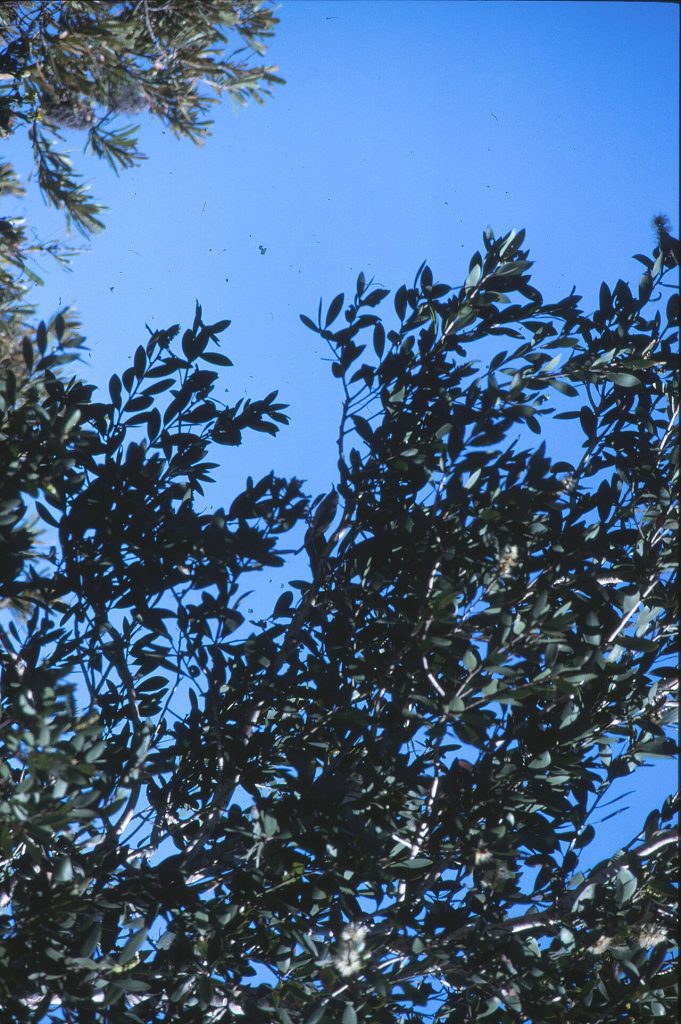
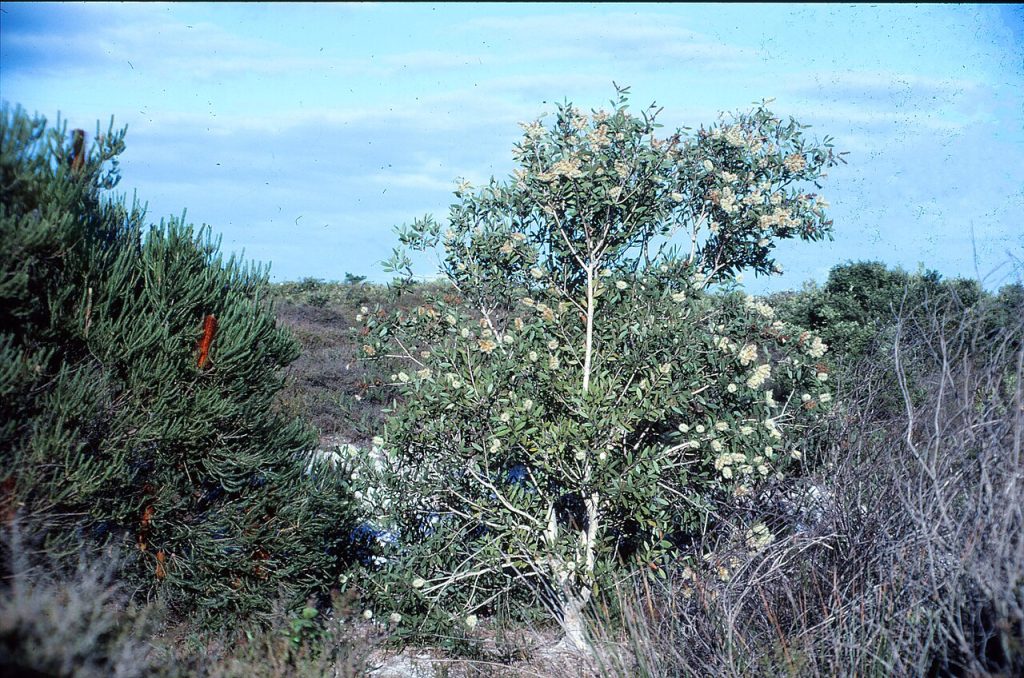
Niaouli is a tree with whitish, spongy bark that peels off in many paper-like layers. The leaves are lance-shaped and stiff, with five clear lengthwise veins. Creamy white flowers form bottlebrush-like spikes at the branch tips.
The tree is introduced to Vietnam. It has been trialled by the Institute of Tree Improvement and Forest Products Development since 2008.
According to Le Dinh Kha and colleagues (2017), selected clones were trial-planted at Ba Vi (Hanoi), Phu Loc (Hue City) and Thanh Hoa (formerly Long An, now Tay Ninh). The best clones gave 1.53–2.61% essential oil, with cineole above 60%.
According to Nong nghiep va Moi truong (Agriculture and Environment) newspaper (2023), the Dong Son cooperative (Ninh Binh) has more than 9 ha of niaouli. A facility in former Quang Nam province (now part of Da Nang City) has planted another 2 ha.
In 2025, a company in Quang Tri reported that it had planted more than 80 ha of niaouli with farmers in the province’s southern communes, in the former Cam Lo district.
Niaouli vs cajuput: what is the difference?
Cajuput (tràm gió, Melaleuca cajuputi) is a native tree. It grows wild on low hills in central Vietnam and in the lowlands of the south. The traditional cajuput oil of Hue and Quang Tri is distilled from this tree.
In the same trials, native cajuput provenances gave only 0.63–1.08% essential oil, with cineole at 16.9–29.8%. Selected niaouli clones gave roughly twice as much oil and clearly more cineole. This is why niaouli has been introduced to improve Vietnamese cajuput-type oil.
Uses
Traditional use
Do Tat Loi’s reference work on Vietnamese medicinal plants describes cajuput and its oil, which is rich in cineole (written there as “xineol”). The oil is described as slightly pungent and cooling. Cajuput leaves and oil are used:
- for steam inhalation, or drinking a leaf decoction, during colds, coughs and nasal congestion;
- in massage for aches, rheumatic pain and feeling chilled;
- as a very dilute solution for washing wounds.
The book also mentions niaouli oil (gomenol), distilled from a Melaleuca species in New Caledonia, with a cineole content similar to cajuput oil. Today, niaouli is used in much the same way as cajuput oil: for inhalation and for rubs on the skin.
What research says
- Antibacterial activity: oils rich in 1,8-cineole show antibacterial and antifungal activity in laboratory tests.
- A feeling of clear breathing: cineole gives a cool, open sensation when inhaled. This is a subjective feeling, not a treatment for respiratory illness.
For information only; not a substitute for medical advice.
One species, several chemotypes
Niaouli is not uniform in its native range. Studies in Australia and New Caledonia have recorded several chemical types (chemotypes): a 1,8-cineole-rich type, a viridiflorol-rich type, and even a type rich in E-nerolidol and linalool.
Commercial niaouli oil is usually the cineole type, with α-terpineol and viridiflorol adding a soft, sweet note. For growers, this means the variety decides oil quality. The clones selected in Vietnam are all high-cineole types, with limonene below 5%.
Four myrtle-family oils compared
| Criterion | Niaouli | Cajuput | Tea tree | Eucalyptus |
|---|---|---|---|---|
| Scientific name | M. quinquenervia | M. cajuputi | M. alternifolia | Eucalyptus globulus |
| Origin | Australia, New Caledonia; introduced | Native to Vietnam | Australia; introduced | Australia; grown in many countries |
| Main components | 1,8-cineole; α-terpineol, viridiflorol | 1,8-cineole, highly variable | Terpinen-4-ol 35–48% | 1,8-cineole ≥70% (ISO 770) |
| Scent | Sharp, cool, lightly sweet | Sharp, warm-cool | Medicinal, fresh-woody | Sharp, strongly cooling |
| Mostly used for | Inhalation, rubs, cosmetics | Inhalation, warming rubs | Skin care, cleaning | Inhalation, rubs, medicated oils |
Applications by industry
| Industry | Applications |
|---|---|
| Balms and rubs | Cajuput-type oil, massage oils, balms |
| Cosmetics | Soaps, shampoos, creams |
| Household | Room diffusing, deodorising sprays, cleaners |
| Raw material | Natural source of 1,8-cineole |
Scent profile and blending
Niaouli smells sharp, cool and clean, softer than eucalyptus, with a light sweet note.
- Blend with mint for a cooling rub or a room scent in the humid season.
- Blend with Java citronella or May Chang for a fresh, clean room spray.
- Blend with camphor for a warming rub with a traditional scent.
How to use at home
- Room diffusing: 3–4 drops in a diffuser. Diffuse for 30–60 minutes, then pause and open a window.
- Steam inhalation (adults): 1–2 drops in a bowl of hot water. Close your eyes and breathe gently for a few minutes.
- Chest, back and sole rub (adults): mix 2–4 drops with 10 ml carrier oil.
- Foot soak: mix 3 drops with a spoonful of salt, then add to a basin of warm water.
Safe use
- Dilute to 1–2% (2–4 drops in 10 ml carrier oil) before applying to skin. Patch-test on your wrist first.
- Do not use on children under 6, and never apply or drip it near a young child’s face or nose. Cineole-rich oils can cause breathing difficulty in small children.
- Pregnant and breastfeeding women, and people with asthma or epilepsy, should ask a doctor before use.
- Do not swallow; keep away from eyes. If swallowed, do not induce vomiting; call 115 (Vietnam emergency) or go to a medical facility, and take the bottle with you.
- Keep away from children and pets. Do not diffuse in a closed room with a cat, and do not apply to dog or cat fur.
How to recognise good oil, and how to store it
- Good oil is clear, colourless to pale yellow, with a sharp, cool, clean scent. It should not smell burnt or sour.
- Standard niaouli oil comes with a COA giving its 1,8-cineole content. It smells sweeter than eucalyptus oil.
- Keep tightly closed, in a cool place, away from sunlight. Best used within 2 years.
Quality specifications
The key specifications are 1,8-cineole content and the chromatogram (α-terpineol, viridiflorol, limonene, α-pinene). Every lot comes with a COA and an MSDS.
Reference figures only; actual specifications follow the COA of each lot.
Why source niaouli oil from Vietnam?
Vietnam has a long tradition of cajuput oil, especially in Hue and Quang Tri. Niaouli builds on that tradition with a higher-yielding, higher-cineole tree.
- Selected clones: Vietnamese forestry research has selected niaouli clones with cineole above 60% and limonene below 5%.
- Growing areas from north to south: trials and plantings exist in Hanoi, Hue City, Tay Ninh, Ninh Binh, Da Nang and Quang Tri.
- Long-lived plantings: niaouli is planted once and can be harvested for many years, which supports a stable leaf supply.
As with any natural oil, composition varies with clone, site and season. Buyers should judge each lot by its own documents.
What buyers usually ask for
Balm makers, cosmetic brands and distributors usually ask for:
- COA for the specific lot, with 1,8-cineole content.
- GC or GC-MS chromatogram, to confirm the chemotype and the minor components.
- MSDS / SDS for handling and transport.
- A sample before contract, to check scent and performance in their own product.
Contact us to discuss current availability and documents.
Growers & cooperatives
The company buys fresh niaouli leaves and young branchlets from plantations. According to Nong nghiep va Moi truong newspaper, niaouli is planted once and can be harvested continuously for many years. Areas of interest:
- Quang Tri (including former Quang Binh province) and Hue City: hill and sandy areas with a cajuput oil tradition.
- Da Nang City (former Quang Nam province), Ninh Binh, Hanoi (Ba Vi).
- Tay Ninh (former Long An province) and other southern lowland areas.
Raw material requirements:
- Fresh leaves and young branchlets, free of old wood, weeds and soil.
- Cut in dry weather and delivered to the still within 1–2 days. Do not leave in heaps for long.
- Priority goes to plantations grown from selected clones, with a known source of planting material.
- We only buy leaves cut from plantations. We do not buy material from clearing natural Melaleuca forest.
In the trials by Le Dinh Kha and colleagues, the leaves of selected clones gave 1.53–2.61% essential oil. Households or cooperatives should send a leaf sample first, so the company can trial-distil it, measure cineole and agree a cutting schedule.
To talk about selling niaouli leaves, call or message on Zalo: +84 983 299 529. See more on the Raw material sourcing page.
Extraction process
- Cut leaves and young branchlets and remove old wood; transport to the still within 1–2 days.
- Steam-distil and separate the oil layer.
- Settle, filter and remove water.
- Analyse 1,8-cineole and the chromatogram, and keep the COA under the lot number.
Frequently asked questions
Is niaouli oil a cajuput oil?
It can be seen as a type of cajuput-style oil, but it is distilled from the introduced species Melaleuca quinquenervia rather than the native cajuput tree.
How is niaouli different from tea tree?
Niaouli is rich in 1,8-cineole and suits inhalation and rubs. Tea tree is rich in terpinen-4-ol and suits skin care products.
Can niaouli oil be used on newborns?
No. Cineole-rich oils should not be used on children under 6, especially near the face and nose.
Where is niaouli grown in Vietnam?
There are trials and plantings at Ba Vi (Hanoi), Phu Loc (Hue City), Thanh Hoa (Tay Ninh), Ninh Binh, Da Nang and Quang Tri.
I have a niaouli plantation. How can I sell the leaves?
Send a leaf sample or message us on Zalo, with the area, tree age and source of planting material, so the company can trial-distil it.
Can niaouli grow on sandy or poor soil?
According to Nong nghiep va Moi truong newspaper, the new Melaleuca varieties have a fairly wide ecological range and grew well even on dry sandy soil in Que Son (Da Nang City). It is still wise to trial a small area first.
Why does the chemotype matter to buyers?
Niaouli has several chemotypes. Buyers of niaouli oil usually expect the cineole type, so a chromatogram confirms what they are getting.
Read more: Tea tree oil Camphor oil Cornmint oil Vietnamese herbal essential oils
Supplying niaouli raw material, or interested in contract growing?
Thảo Dược Xanh buys raw materials and provides technical support to farmers and cooperatives in Vietnam.
References: Promising niaouli clones for essential oil production in Vietnam (Vietnam Journal of Science and Technology, 2017) · Two new Melaleuca varieties with high oil quality (Nong nghiep va Moi truong) · Cajuput tree and cajuput oil – Do Tat Loi, Medicinal Plants of Vietnam