Patchouli oil is steam-distilled from the dried and lightly fermented leaves of patchouli (hoắc hương), Pogostemon cablin. Its main component is patchoulol, which gives a warm, earthy, woody scent that lasts a very long time.
In traditional Vietnamese medicine, patchouli is used for heat stroke and bloating. The oil is a classic base note in perfume and soap, and is also used to repel insects that damage fabric.
Quick facts
- Scientific name
- Pogostemon cablin (Blanco) Benth.
- Trade name
- Patchouli oil
- Part used
- Leaves dried in shade and lightly fermented
- Method
- Steam distillation
- Appearance and odour
- Amber to brown; viscous; warm, earthy, woody scent
- Main components
- Patchoulol 27–40%; α-bulnesene, α-guaiene, seychellene
- Storage
- Dark glass bottle, tightly closed; the scent rounds out with age
What is patchouli oil?
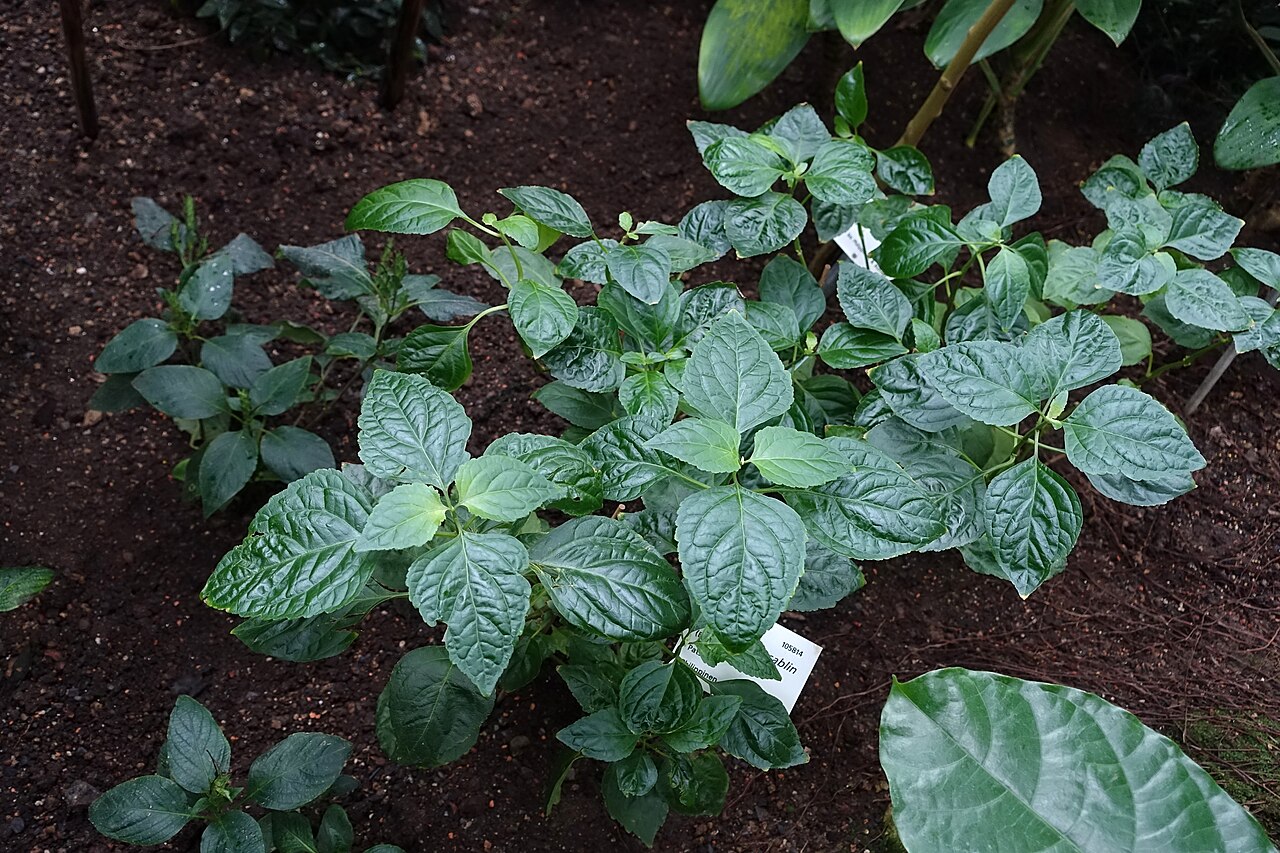
Patchouli is a herb in the mint family (Lamiaceae), with large, toothed, softly hairy leaves. Fresh leaves smell only faintly when crushed. The typical scent appears clearly only after the leaves are wilted and then fermented in a pile.
Distilling these processed leaves gives a thick oil, amber to brown in colour. It smells warm, earthy and woody, slightly sweet and smoky.
Patchouli is one of the few essential oils that “gets better with age”. Freshly distilled oil still smells sharp and green. After a few months to a few years, the scent becomes rounder and smoother. Because it lasts so long, patchouli is used as a fixative in perfumery.
What does the patchouli plant look like, and where does it grow?
The plant is 0.5–1 m tall, with square stems and many branches. Its leaves grow in opposite pairs and are egg-shaped, thick and hairy. It is propagated by cuttings and rarely flowers in Vietnam.
Patchouli likes a hot, humid climate (22–28 °C) with plenty of rain. It needs fertile, well-drained soil and prefers light shade of 25–50%.
In Vietnam, patchouli is grown in small, scattered plots, mainly as a medicinal herb. Growing areas include Ha Noi, Hai Phong (formerly Hai Duong), Bac Ninh, Hung Yen, Ninh Binh (formerly the Ha Nam area) and Dong Thap (formerly the Tien Giang area).
There is no large commercial growing area yet. Indonesia is currently the world’s largest producer of patchouli oil.
Patchouli in traditional medicine and daily life
Patchouli appears in many traditional summer remedies for colds. The best known is the formula “huo xiang zheng qi san” (hoắc hương chính khí tán). In traditional medicine it is used for heat stroke, vomiting and bloating.
In the 19th century, dried patchouli leaves were packed between shawls and silk from India. This kept moths away on the long voyage to Europe. The scent of patchouli became linked with fine fabrics from the East. Today it is a familiar base note in many woody and oriental perfumes.
Uses
Traditional use
Patchouli is described as pungent and warming. In traditional Vietnamese medicine, patchouli is used:
- for heat stroke, colds, mild fever and headache;
- for vomiting, bloating, diarrhoea and indigestion;
- to freshen the breath and reduce bad breath.
What research says
- Antifungal and antibacterial: in laboratory tests, patchouli oil inhibits some fungi and bacteria.
- Insect repellent: it has long been used to protect fabric from moths. Some trials show it repels ants and mosquitoes for a short time.
- Relaxing scent: its warm, earthy aroma is often used in room diffusing, meditation and yoga to create a calm mood.
For information only; not a substitute for medical advice.
Patchoulol: why does patchouli last so long?
Patchoulol is a sesquiterpene alcohol with a heavy molecule that evaporates very slowly. So the scent of patchouli clings to skin and fabric for a long time. It also helps “hold” lighter notes in a perfume so they do not fade quickly. Patchoulol content is the main specification used to price patchouli oil.
The oil sits in secretory cells inside the leaf, and it does not escape easily from fresh leaves. Drying in the shade and fermenting weaken the cell walls, so steam can carry the oil out more easily. This is why post-harvest leaf handling has a big effect on both oil yield and quality.
Applications by industry
| Industry | Applications |
|---|---|
| Perfumery | Base note, fixative |
| Cosmetics | Soap, hair oil, shower gel |
| Household | Incense, scented candles, fabric softener, wardrobe sachets |
| Raw material | Isolation of patchoulol |
Vietnamese patchouli and other origins
Indonesia is the world’s largest producer of patchouli oil. Vietnamese patchouli is a small, emerging origin. Buyers should know both its limits and its potential.
- Yield: dried leaves in Vietnam give about 0.5–1.2% oil. Good growing areas in Indonesia reach 1.3–2.2%.
- Scale: Vietnam has no large commercial patchouli area yet. Supply is built through new contract-growing with households and co-ops.
- Traceability: a small, contract-based supply chain makes it easier to know which farms and which leaf lots went into each batch.
- Diversification: some buyers like to add a second origin to reduce dependence on a single country.
For now, Vietnamese patchouli suits buyers who value traceability and long-term partnership more than large spot volumes.
Scent profile and blending
Patchouli smells earthy, woody, warm, slightly sweet and smoky. It is strong, so use only a little.
- Blend with orange and white champaca leaf for a warm, soft oil perfume.
- Blend with cinnamon and ginger for winter candles.
- Blend with Java citronella for wardrobe sachets that smell good and also repel insects.

How to use at home
- Wardrobe: put 3–4 drops on a wooden block or cloth bag to scent clothes and repel moths. Add more when the smell fades.
- DIY oil perfume: 1 drop patchouli + 2 drops orange + 10 ml jojoba oil.
- Room diffusing: 2 drops, blended with Java citronella or cinnamon.
- DIY fabric softener: add 3–5 drops to the softener compartment for one wash.
DIY anti-moth sachet for your wardrobe
Take a small cotton bag and fill it with a handful of wood shavings, or dried patchouli leaves if you have them. Add 5 drops patchouli, 3 drops Java citronella and 2 drops camphor. Tie it closed and hang it, or place it between stacks of clothes. Add a few drops every 2–3 weeks.
Camphor can be poisonous if a child swallows it, so hang the sachet high, out of children’s reach. Do not drip oil directly onto light-coloured fabric. Patchouli oil is coloured and may leave a stain.
Safe use
- Dilute before applying to skin (about 1–2%, that is 2–4 drops in 10 ml carrier oil). Patch-test on your wrist first.
- Do not swallow; keep away from eyes; keep out of children’s reach. If swallowed, do not induce vomiting. Go to a medical facility and take the bottle with you.
- Pregnant or breastfeeding women, and parents of young children, should ask a doctor before use.
- People taking blood-thinning medicines should ask a doctor before regular skin use.
- The scent is very long-lasting, so use a little, especially in small rooms. Do not diffuse for long in rooms with cats or pet birds.
How to recognise good oil, and how to store it
- Good oil is viscous and amber to brown. It smells warm, earthy and woody, never sour or burnt.
- Freshly distilled oil may smell a bit harsh. This is not a defect; after a few months of resting, the scent softens.
- Keep tightly closed and away from sunlight. Patchouli oil keeps well for many years.
Fresh, wilted or fermented leaves?
| Leaf handling | Oil yield | Notes |
|---|---|---|
| Fresh leaves | Very low | Oil cells not yet broken |
| Wilted leaves | Medium | Dried in the shade for 2–5 days |
| Wilted, then fermented | Highest | Piled and fermented for a few days after drying |
| Heat-dried above 40 °C | Low | Oil is lost with heat; not recommended |
Quality specifications
The main specification is patchoulol, with ISO 3757 as the reference standard. Dried leaves give about 0.5–1.2% oil in Vietnam, compared with 1.3–2.2% in good Indonesian growing areas. Every lot comes with a COA and an MSDS.
Reference figures only; actual specifications follow the COA of each lot.
What buyers usually ask for
Patchouli is a high-value oil, so buyers tend to check it closely. These are the usual requests.
- Patchoulol content: this is the first number most buyers look at. Ask for it on the COA of the specific lot.
- Full chromatogram: perfumers often compare the whole profile, not only patchoulol, with a reference oil.
- Age of the oil: because patchouli matures, buyers may ask when a lot was distilled.
- COA and MSDS: every lot has both.
- Sample before contract: most buyers smell and test a sample first. Contact us to discuss what is available.
Growers & cooperatives
The company is looking for households and co-ops to start new contract-growing in hot, humid, rainy areas with fertile soil that does not waterlog. The northern delta and midlands, the Central Highlands and southern Vietnam may all be suitable.
- First harvest after 5–8 months, then 2–4 harvests a year, for about 3 years. The plant likes light shade and can be intercropped in fruit orchards.
- Do not cut when the leaves are still wet from rain or dew.
- Leaf handling: dry in the shade with good airflow for 2–5 days, then ferment. Avoid strong sun, and do not dry above 40 °C.
- Free planting material and technical support for growing and leaf fermenting; signed purchase contracts.
To start growing patchouli with us, call or message on Zalo: +84 983 299 529. See more on the Raw material sourcing page.
Extraction process
- Cut stems and leaves in dry weather; dry in the shade, strip the leaves and ferment them in a pile.
- Steam-distil for a long time (the oil is heavy and comes over slowly).
- Separate, filter and let the oil settle and stabilise.
- Test patchoulol content and keep the COA under the lot number.
Frequently asked questions
Why does patchouli oil smell better with age?
Freshly distilled oil still smells sharp. Over time, its components settle, and the scent becomes rounder and sweeter.
Can patchouli keep moths away from clothes?
Patchouli has been used to protect fabric since the 19th century. Its scent helps deter moths but does not kill an existing infestation. You still need to wash and air your clothes, and refresh the oil when the smell fades.
Will patchouli scent stick to my clothes?
Yes, because patchoulol evaporates very slowly. If you do not like a strong smell, put the sachet in a corner of the wardrobe instead of between your clothes.
Why are the leaves fermented before distilling?
Fermenting breaks the oil cells in the leaves. This gives much more oil than distilling fresh leaves.
Does everyone like the smell of patchouli?
Not always. Its earthy, smoky character is quite polarising. Blending with orange or white champaca makes it easier to enjoy.
Can patchouli be intercropped in a garden?
Yes. It likes light shade, so planting it under a thin fruit-tree canopy works quite well.
What patchoulol level should a buyer expect?
Typical patchouli oil contains 27–40% patchoulol. The actual figure for each lot is shown on its COA.
I want to grow patchouli. How do I start?
Contact us. The company will survey your land, supply planting material, show you how to ferment the leaves and sign a purchase contract.
Read more: White champaca leaf oil Homalomena oil Clove basil oil Vietnamese herbal essential oils
Supplying patchouli raw material, or interested in contract growing?
Thảo Dược Xanh buys raw materials and provides technical support to farmers and cooperatives in Vietnam.
References: Patchouli – Do Tat Loi, Medicinal Plants and Remedies of Vietnam · PROSEA – Pogostemon · Patchouli oil collected in Cai Lay