Homalomena oil is steam-distilled from the dried rhizomes of Homalomena occulta, a plant that grows under the canopy of humid forests. Its main component is linalool (about 40–60%), together with terpinen-4-ol. The result is a warm, woody, lightly spicy scent.
In Vietnam, the rhizome is a well-known traditional remedy for “wind-damp” joint complaints. The oil is used in massage oils, incense and woody perfume notes.
Quick facts
- Scientific name
- Homalomena occulta (Lour.) Schott
- Trade names
- Homalomena oil, Qian nian jian oil
- Part used
- Dried rhizome
- Method
- Steam distillation
- Appearance and odour
- Pale yellow; warm, woody, lightly spicy, slightly floral
- Main components
- Linalool 40–60%; terpinen-4-ol, α-terpineol
- Storage
- Dark glass bottle, tightly closed, in a cool place
What is homalomena oil?
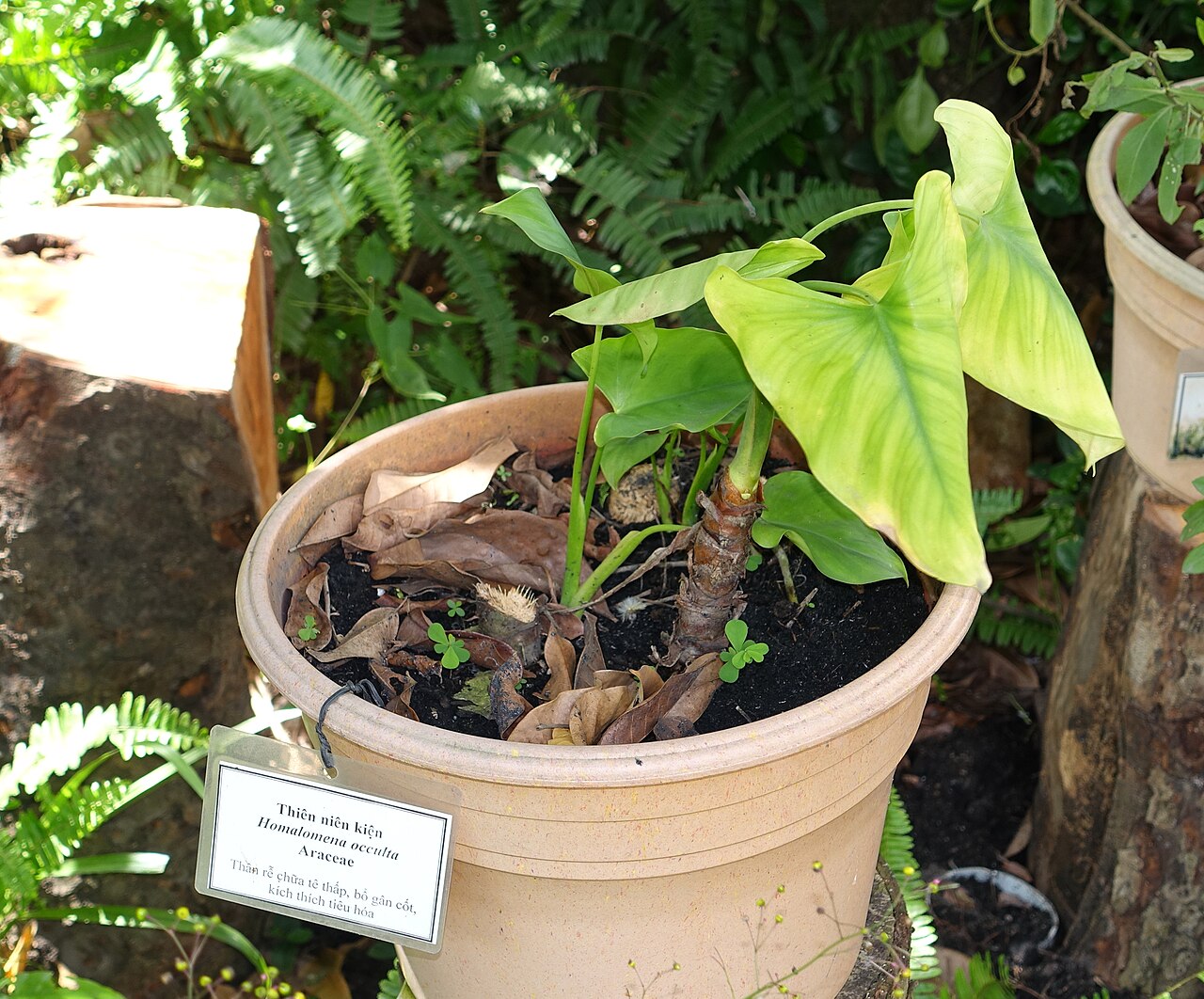
Homalomena (thiên niên kiện) is a herbaceous plant of the arum family (Araceae). It grows in clumps on the forest floor. Other Vietnamese names include sơn thục and ráy hương.
The part used is the long, fibrous rhizome, which has a typical woody smell. The rhizomes are sun-dried and then steam-distilled. This gives a pale yellow oil with a warm, woody, slightly spicy and faintly floral scent.
The Vietnamese name means “a thousand years of strength”. It refers to the plant’s traditional role in strengthening tendons and bones. The same plant is known in Chinese herbal tradition as qian nian jian.
Homalomena oil is less common than many other essential oils. The raw material is mostly wild-harvested, and the oil yield is only about 1%.
What does the plant look like, and where does it grow?
The plant is 0.5–1 m tall. Its leaves are arrow-shaped or heart-shaped, on long stalks, and grow in clumps. The rhizome creeps horizontally under the soil and is about 1–2 cm thick. When broken, it shows many stiff fibres and releases a clear aroma.
Homalomena grows wild in humid forests and along streams. In Vietnam it has been recorded in Thanh Hoa (Xuan Lien), Nghe An, Lang Son, Lao Cai, Gia Lai and along the Truong Son range. In Hue, it occurs in Phong Dien, A Luoi, Nam Dong and Phu Loc.
In some places the plant regenerates well and grows quite densely. However, there are no commercial plantations yet.
Homalomena in everyday life
For people in Vietnam’s mountain areas, homalomena is a familiar remedy. The rhizome is soaked in rice wine and rubbed on sore backs and tired knees. This is common among people who farm hillside fields or work in the forest.
The dried rhizome is also ground into powder and mixed into incense sticks. Its warm, gentle woody scent suits traditional incense well.
The classic Vietnamese reference by Do Tat Loi notes that Vietnam could once purchase up to about 3,000 tonnes of homalomena per year. This figure shows how heavily the plant was harvested in the past. It is the reason controlled harvesting matters today, so that wild stands can regenerate.
Uses
Traditional use
In traditional Vietnamese medicine, homalomena is described as bitter, pungent, slightly sweet and warm in nature. It is used to:
- dispel “wind-damp” and strengthen tendons and bones;
- ease aching joints and bones, back pain, tired knees, numb limbs and cramps;
- prepare medicinal wine for drinking or for massage, often combined with other herbs such as cibotium (cẩu tích), achyranthes (ngưu tất) and eucommia (đỗ trọng).
What research says
- Anti-inflammatory and antibacterial activity: in laboratory tests, homalomena oil and extracts show anti-inflammatory and antibacterial activity.
- Relaxation: linalool, the main component, has been studied for its relaxing effect when inhaled.
For information only; not a substitute for medical advice.
Industrial applications
| Sector | Applications |
|---|---|
| Pharmaceutical, rubbing oils | Massage oils, herbal liniments for joints |
| Incense | Incense sticks, cones, aromatic smoke blends |
| Perfumery | Warm woody notes, oriental accords |
| Household | Room scenting, odour masking |
Formulators value homalomena oil as a natural source of linalool with a woody, spicy background. This makes it different from floral linalool sources. It can add depth to blends where a plain linalool would feel thin.
Scent profile and blending
Homalomena smells warm, woody and lightly spicy, with a faint floral touch. People who use traditional incense find it familiar.
- Blend with cassia and ginger for warming massage oils.
- Blend with patchouli and white champaca leaf for perfumes and incense.
- Blend with orange for a warm, pleasant room scent.

How to use at home
- Massage for stiff shoulders, neck or knees: dilute 2–3 drops in 10 ml of carrier oil. Massage until the skin feels warm.
- Foot soak: mix 2–3 drops with a small spoonful of carrier oil, add to a basin of warm water and stir well. Essential oil does not dissolve in water, so mix it with oil first.
- Room scent: 2–3 drops in a diffuser; it works well with cassia and ginger.
DIY “joint comfort” massage oil for adults
Mix 30 ml of coconut or sesame oil with 5 drops of homalomena, 3 drops of ginger and 2 drops of camphor oil. Shake well and store in a dark bottle. Apply to tired, aching areas without open wounds, and massage until warm.
Stop if the skin turns red or itchy. This recipe contains camphor, so do not use it on children, pregnant women or people with a history of seizures. Joints that are swollen and hot, or pain that lasts, need a medical check to find the cause.
Safe use
- Dilute before applying to skin, and do a patch test on the wrist first.
- Do not swallow essential oil, and do not apply it to open wounds. If swallowed, seek medical care.
- Not for use during pregnancy or breastfeeding, or on young children.
- Keep out of reach of children and pets. Do not diffuse for long periods in closed rooms with dogs or cats.
How to recognise good oil and store it
- Good oil is pale yellow and clear. It smells warm, woody and slightly floral, never sour or musty.
- Mouldy rhizomes give the oil an unpleasant damp smell. For this reason, the company checks the dryness of the raw material carefully.
- Keep tightly closed and away from sunlight. Best used within about 2 years.
Natural linalool sources from Vietnamese plants
| Source | Part used | Linalool | Background scent |
|---|---|---|---|
| Homalomena | Rhizome | About 40–60% | Warm wood, spice |
| White champaca leaf | Leaves, twigs | About 70–80% | Floral wood, green |
| Linalool-type camphor tree | Leaves | Can exceed 90% | Floral, soft wood |
Each of these oils gives linalool with a different “frame” around it. Homalomena is the warmest and woodiest of the three. Buyers often choose between them based on the background notes their formula needs.
Quality parameters
The main quality parameter is the chromatogram, with a focus on linalool and terpinen-4-ol. Dried rhizomes yield about 0.8–1% essential oil. Every batch comes with a COA and an MSDS.
A 2026 paper in the Hue University Journal of Science reported linalool at about 40% and terpinen-4-ol at about 8.5%. Older literature reports linalool of up to about 60%, depending on the sample.
Reference figures only; actual specifications follow the COA of each batch.
Why source homalomena oil from Vietnam?
Homalomena occulta is native to the forests of Vietnam and neighbouring countries. Vietnam has a long record of using and trading the rhizome. Its wild range runs through many provinces, from the north to the Central Highlands.
Because supply depends on wild stands, traceability matters. Buyers increasingly want to know where the raw material comes from and how it was harvested. Our approach is to buy only from harvesters who follow simple regeneration rules, described below.
We also record the area, harvest date and harvester for each lot of raw material. This makes it possible to link each batch of oil back to its source.
What buyers usually ask for
International buyers of homalomena oil usually ask for the same core documents and steps:
- COA (certificate of analysis) for the batch, including the main components.
- GC-MS chromatogram, to check linalool and terpinen-4-ol levels and the overall profile.
- MSDS (safety data sheet) for handling, storage and transport.
- A sample before contract, so the scent and profile can be tested in the buyer’s own formula.
Because supply is limited and the profile varies by sample, we recommend that buyers test a sample first. Planning purchases ahead of the main collection season also helps.
Growers & cooperatives
The company buys dried rhizomes that are clean, free of small roots and not mouldy. Rhizomes can be harvested all year round, but our main buying season is August to December. Priority areas are Thanh Hoa, Nghe An, Hue, Gia Lai, Lang Son, Lao Cai and the provinces along the Truong Son range.
Requirements and commitments:
- Rhizomes must be washed, with small roots removed. They can be sliced or left whole, then sun-dried until brittle.
- Sustainability commitment: harvesters must leave the base and young plants so the clump can regenerate. We do not buy plants dug out completely, or material taken from special-use forests.
- We give priority to households and cooperatives growing homalomena under production forests. The company is ready to support trial planting.
To sell rhizomes or ask about trial planting, call or message us on Zalo at +84 983 299 529. See more on the Raw material sourcing page.
How should homalomena be harvested so it regenerates?
Homalomena grows in clumps and spreads through its rhizomes. If a whole clump is dug up, the plant is almost lost from that spot. If only part is taken, the clump grows back after a few years. The company teaches harvesters a few simple rules:
- Take only large, mature clumps; leave small clumps and young plants.
- From each clump, take only about half to two-thirds of the rhizome. Leave the part with buds and cover it with soil.
- Rotate harvesting areas, and let each area rest for a few years.
- Never harvest in special-use forests or protected areas.
At the same time, the company encourages trial planting of homalomena in damp, shaded places. It can be grown under production forests or in fruit orchards. This creates a stable supply of raw material and reduces pressure on wild plants.
Extraction process
- Check dryness and mould; chop the rhizomes into small pieces.
- Steam-distil and separate the oil layer.
- Filter and remove water.
- Test the oil and keep the COA under its batch code.
Frequently asked questions
Does homalomena oil help with aching joints?
In traditional Vietnamese medicine, homalomena is a remedy for “wind-damp” conditions. Massage with diluted oil makes tired, aching areas feel warm and comfortable. Pain that lasts, or joints that are swollen and hot, need a medical check.
What does homalomena oil smell like?
It smells warm, woody and lightly spicy, with a faint floral note. People who use traditional incense usually find it familiar.
Why is supply limited?
The raw material is mostly wild-harvested, and the oil yield is about 1%. The company also accepts only sustainably harvested material.
Can I add the essential oil to homalomena medicinal wine and drink it?
No. The essential oil is only for external use after dilution. Traditional medicinal wine is made by soaking the rhizome, without adding essential oil.
Can incense makers buy by the kilogram?
Yes, with a sample for testing and a COA.
How does homalomena oil differ from other linalool oils?
It has a warmer, woodier and spicier background than white champaca leaf oil or linalool-type camphor oil. It also contains notable terpinen-4-ol.
Can I get a sample and documents before ordering?
Yes. We provide a sample together with the COA and MSDS. Contact us by phone or Zalo to discuss your needs.
I collect homalomena in the forest. How can I sell it?
Call or message us on Zalo. The company will show you how to harvest while leaving the base, and quote a price for dried material.
Read more: White champaca leaf oil Shampoo ginger oil Patchouli oil Vietnamese herbal essential oils
Supplying homalomena raw material, or interested in contract growing?
Thảo Dược Xanh buys raw materials and provides technical support to farmers and cooperatives in Vietnam.
References: Homalomena – Do Tat Loi · Homalomena essential oil (Hue University Journal of Science)