White champaca leaf oil is steam-distilled from the leaves of the white champaca tree (ngọc lan trắng), Michelia × alba. Its main component is linalool (about 70–80%), giving a soft, clean floral-woody scent.
Linalool has been widely studied for its relaxing effect when inhaled. The oil is used in bedroom diffusing, perfumery and cosmetics.
Quick facts
- Scientific name
- Michelia × alba DC. (synonym Magnolia × alba)
- Trade name
- White champaca leaf oil, Michelia alba leaf oil
- Part used
- Leaves, small twigs
- Method
- Steam distillation
- Appearance and odour
- Colourless to very pale yellow; floral, woody, slightly green scent
- Main components
- Linalool 70–80%; (E)-nerolidol, β-caryophyllene
- Storage
- Dark glass bottle; close tightly right after use
What is white champaca leaf oil?
White champaca is famous for its fragrant flowers, but its leaves contain essential oil too. Steam-distilling the leaves and small twigs gives an almost colourless oil. It smells lightly floral and woody, a little green, and much softer than the flower.
Products from champaca flowers are very expensive, because the flowers are few and yield very little oil. Leaf oil smells different from the flower, but costs less and the raw material is far more plentiful. It is also a natural source of linalool that interests the perfume and cosmetics industries.
What does the white champaca tree look like, and where does it grow?
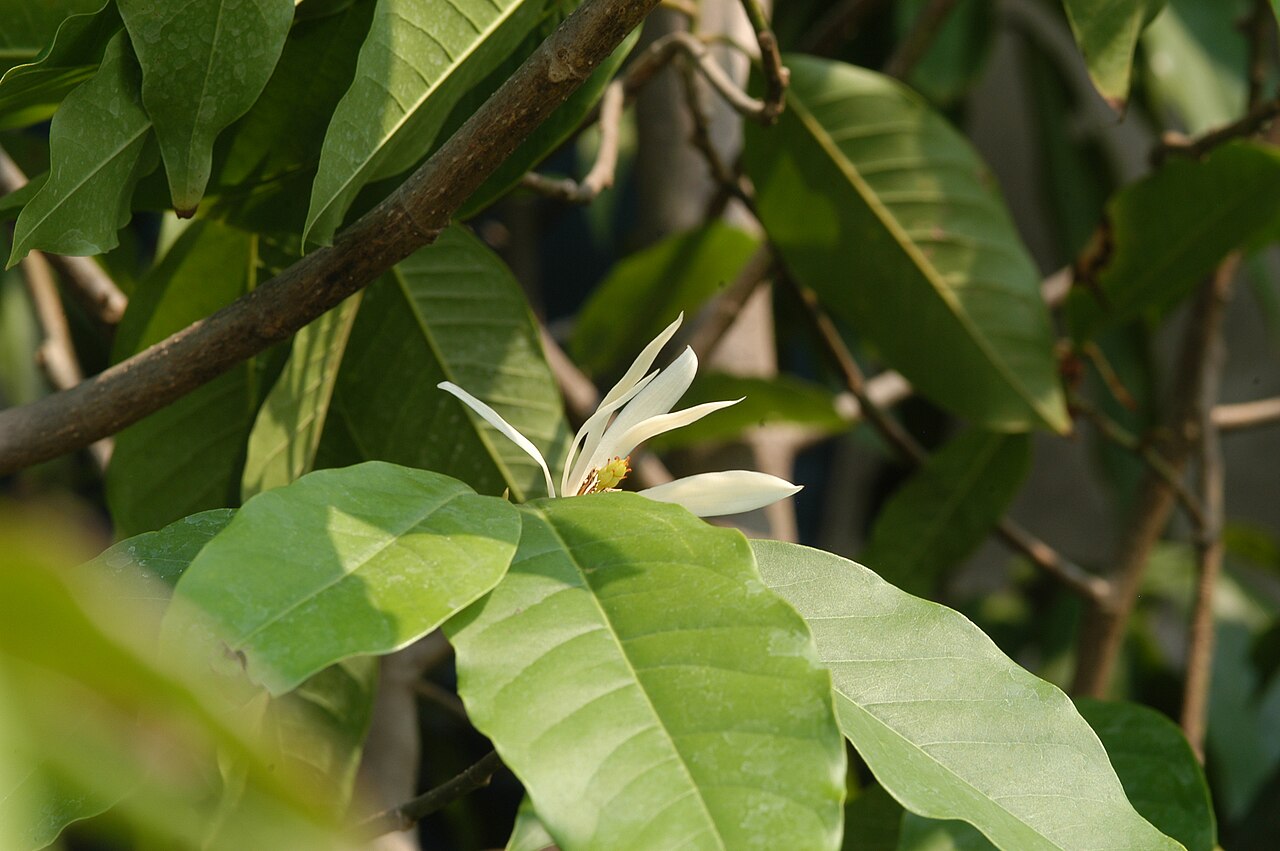
White champaca is a tree 10–20 m tall, with a wide crown and large, glossy, oval leaves. The flowers are ivory-white with long petals. They open here and there for many months, peaking in summer. In recent literature the tree is often placed in the genus Magnolia, as Magnolia × alba.
It is a hybrid and is not found growing wild. The tree is grown in tropical and subtropical regions, usually below 1,000 m.
In Vietnam, white champaca is planted everywhere for ornament, shade and flowers. You find it in home gardens, temples, pagodas, schools and parks. It grows fast and needs regular pruning, and these leaf and branch prunings are the raw material for distillation.
White champaca in Vietnamese daily life
White champaca flowers are tied to many people’s memories. The white blossoms are tucked into hair, placed on family altars, used to scent tea and set on plates to perfume a room. In Ha Noi, street vendors selling trays of champaca flowers on summer mornings are a familiar sight.
In folk practice, champaca flowers and leaves are also used as a remedy for mild coughs. The leaf oil brings part of this familiar scent into everyday products.
Uses
Folk use
- In Vietnamese folk practice, champaca flowers and leaves are boiled into a drink for coughs and mild sore throats.
- The flowers are used to scent tea and placed in rooms to perfume the air and help people sleep.
What research says
- Relaxation and sleep: in many trials, inhaling linalool reduced stress and anxiety and helped with sleep. Most results come from animal studies; a few come from small human studies.
- Mild antimicrobial activity: in laboratory tests, linalool shows mild antibacterial and antifungal activity.
For information only; not a substitute for medical advice.
Linalool: a fragrance found everywhere
Linalool is one of the most common aroma compounds in nature. It is found in lavender, bergamot, coriander, rosewood and very many flowers. Its fresh floral-woody scent is pleasant to most people. So it appears in many perfumes, soaps and shampoos.
In the past, a major natural source of linalool was South American rosewood, which is now restricted. That is why linalool from the leaves of cultivated trees is gaining interest as a more sustainable option. Two notable sources are white champaca leaf and Ho leaf (linalool-type camphor tree).
Why use pruned champaca leaves?
Every year, champaca trees in cities and gardens need pruning. Pruning stops branches breaking in storms and keeps them clear of power lines. Most of these leaves and branches are thrown away or burned.
Collecting them for distillation reduces green waste. Garden owners and tree-care companies earn a small extra income. And each oil lot is a source of natural linalool that does not require cutting down a single extra tree.
Applications by industry
| Industry | Applications |
|---|---|
| Perfumery | Floral-woody note; base for white-flower accords |
| Cosmetics | Shower gels, creams, massage oils |
| Household | Bedroom diffusing, fabric softener |
| Raw material | Natural linalool source |
Why source champaca leaf oil from Vietnam?
White champaca is grown across tropical and subtropical Asia. In Vietnam, it is one of the most common ornamental trees, which gives a few practical advantages.
- Plentiful raw material: trees grow in home gardens, temples, schools and parks all over the country.
- By-product, not new felling: the oil is made from routine prunings, so no trees are cut for it.
- Year-round collection: leaves are collected all year, following pruning schedules.
- Natural linalool story: leaf oil from cultivated trees is a more sustainable option than linalool from restricted rosewood.
Oil yield from fresh leaves is low, about 0.2–0.4%. So supply depends on collecting large volumes per trip, and planning ahead helps.
Scent profile and blending
Champaca leaf oil smells soft, clean, floral and woody, never harsh. It is easy to use for people who are new to essential oils.
- Blend with orange and pomelo for a bright living-room scent.
- Blend with patchouli for a warm, long-lasting oil perfume.
- Blend with mint (a very small amount) for a cool, gentle room spray.

How to use at home
- Bedroom diffusing: 3–4 drops in a diffuser. Run for about 30 minutes before bedtime, then switch off.
- Relaxing massage: mix 2–3 drops with 10 ml carrier oil.
- Oil perfume: blend with patchouli and orange in jojoba oil.
DIY relaxing pillow spray
Mix 50 ml distilled water, 5 ml 70% alcohol, 6 drops champaca leaf oil and 2 drops orange. Shake well before each use and spray lightly once over the pillow and blanket. Spray 10–15 minutes before bed so the alcohol evaporates.
Do not spray directly on the face, and do not use on young children’s pillows. Use up within about 2 weeks.
Diffusing the right way
Diffusing is most pleasant when you use a little oil and run the diffuser in short sessions, not all night.
| Room size | Amount of oil | Diffuser run time |
|---|---|---|
| Under 15 m² | 2–3 drops | 20–30 minutes |
| 15–25 m² | 3–4 drops | 30–45 minutes |
| Over 25 m² | 5–6 drops | 45–60 minutes, pause, then run again |
Keep a door or window slightly open; switch off if you get a headache or feel unwell. Do not diffuse in a newborn’s room. In rooms with people who have asthma, or with pets, use less oil and shorter sessions.
Safe use
- Dilute before applying to skin, and patch-test on your wrist first.
- Oxidised linalool can easily irritate skin. Close the bottle tightly after each use; discard old oil that has a strange, sharp smell.
- Do not swallow; keep away from eyes. If swallowed, rinse your mouth and contact a medical facility for advice.
- Pregnant or breastfeeding women should ask a doctor before use. Do not apply to young children’s skin.
- Keep out of reach of children and pets, especially cats.
How to recognise good oil, and how to store it
- Good oil is almost colourless, with a light, clean floral-woody scent.
- A sharp or sour smell is a sign of oxidation.
- Use a dark bottle, close it tightly and keep it cool. Best used within about 1–2 years of opening.
Champaca leaf oil and champaca flower products
| Criterion | Leaf oil | Flower products |
|---|---|---|
| Raw material | Leaves, pruned twigs | Flowers, usually solvent-extracted into an absolute |
| Scent | Light floral-woody, green | Sweet, rich floral |
| Linalool | About 70–80% | Main component, with many other aroma compounds |
| Price | Moderate | Very high |
Quality specifications
The main specification is linalool. A study of samples from northern Vietnam found about 73% linalool in leaf oil and about 80% in twig oil. Fresh leaves yield about 0.2–0.4% essential oil.
In the EU, linalool is a fragrance allergen that must be labelled on cosmetics above a threshold. The COA helps companies calculate its level in their formulas.
Reference figures only; actual specifications follow the COA of each lot.
What buyers usually ask for
Buyers of champaca leaf oil are mostly in fragrance and cosmetics, and they tend to focus on a few points.
- Linalool content: shown on the COA of each lot, and needed for allergen labelling calculations.
- Full chromatogram: perfumers compare the minor components, such as nerolidol and caryophyllene, with a reference oil.
- Freshness: because linalool oxidises, buyers often ask about distillation date and storage.
- COA and MSDS: every lot comes with both.
- Sample before contract: most buyers smell and test a sample first. Contact us to discuss what is available.
Growers & cooperatives
The company buys fresh leaves and small twigs from crown pruning in home gardens, nurseries and urban tree-care works.
- Collection all year, following pruning schedules. Leaves must be fresh, not rotting, and not mixed with leaves of other trees.
- Oil yield is low, so we prioritise sources that can supply large volumes per trip.
- We welcome contract-growing of white champaca for both flowers and leaves.
- Sustainability commitment: we collect only leaves and pruned twigs. We do not buy felled trees.
To arrange a collection, call or message on Zalo: +84 983 299 529. See more on the Raw material sourcing page.
Extraction process
- Collect leaves and small twigs during crown pruning; distil within 1–2 days so the leaves do not heat up.
- Steam-distil and separate the oil layer.
- Filter and remove water.
- Test linalool content and keep the COA under the lot number.
Frequently asked questions
How is champaca leaf oil different from champaca flower products?
Flower products smell sweet and rich, and they are very rare and expensive. Leaf oil smells lightly floral-woody and is easy to use every day.
Does champaca leaf oil help you sleep?
Linalool has been studied for its relaxing effect when inhaled, and many people find it easier to sleep after diffusing it. If insomnia lasts a long time, see a doctor.
Does champaca leaf oil smell like lavender?
Both are rich in linalool, so they share some character. Champaca leaf leans more floral-woody, with less of the herbal note of lavender.
Can pregnant women use it?
Ask a doctor before using any essential oil.
Do cosmetic makers need to label linalool?
In the EU, linalool must be labelled on cosmetics above a threshold. The COA of each lot helps you calculate its level in your formula.
How many leaves does one champaca tree give?
It depends on the size of the tree and how it is pruned. The company will come to look and confirm before collecting.
I have a large champaca tree that needs pruning. Will you buy the leaves?
Yes, if the volume is enough for one collection trip. Call to arrange a date.
Read more: Patchouli oil Homalomena oil Litsea cubeba oil Vietnamese herbal essential oils
Supplying white champaca leaf raw material, or interested in contract growing?
Thảo Dược Xanh buys raw materials and provides technical support to farmers and cooperatives in Vietnam.
References: Composition of white champaca leaf and twig oils (Vietnam Journal of Biology) · PROSEA – Michelia