Star anise oil is steam-distilled from the fruit of the star anise tree, Illicium verum. Its main component is trans-anethole (about 85–93%), which gives the typical sweet anise scent.
In traditional Vietnamese medicine, star anise is a warming remedy used for bloating and indigestion. The oil is used in food flavourings, toothpaste and warming rubs. Our raw material comes from Lang Son, home to about 70% of Vietnam’s star anise area, and from Cao Bang.
Quick facts
- Scientific name
- Illicium verum Hook.f.
- Trade name
- Star anise oil
- Part used
- Fruit (fresh or dried); a branch-and-leaf oil also exists
- Method
- Steam distillation
- Appearance & odour
- Colourless to pale yellow; sweet anise scent; solidifies in cold weather
- Main components
- trans-Anethole 85–93%; limonene, estragole (minor)
- Storage
- Dark glass bottle, tightly closed; turning white and solid in the cold is normal
What is star anise oil?
Star anise oil is the fragrant, volatile part of the star anise fruit. It is obtained by steam-distilling fresh fruit or crushed dried fruit. The oil is clear, colourless to pale yellow, with a sweet, liquorice-like scent.
A special feature: in cold weather, star anise oil sets into a cloudy white mass because the anethole crystallises. When warmed, it becomes clear again.
Branches and leaves of the star anise tree can also be distilled, but that oil smells weaker and contains less anethole. Fruit oil is the type preferred by the food and beverage flavour industry.
What does the star anise tree look like, and where is it grown?
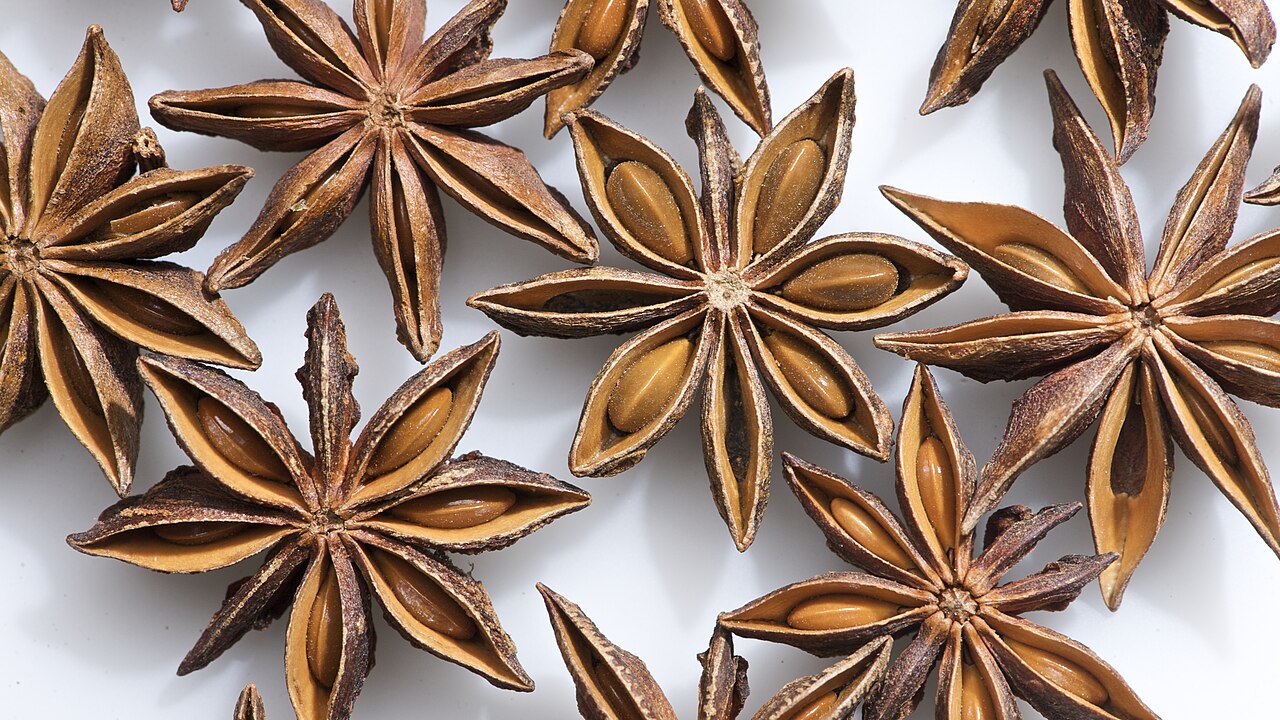
Star anise (hồi) is an evergreen tree, 6–10 m tall, with a pyramid-shaped crown and thick, glossy leaves. The fruit is star-shaped with 6–8 points, and each point holds one shiny seed.
The tree prefers a cool, moist climate and well-drained hill soil. It grows best on the limestone mountains and hill land of the northeast.
Lang Son has more than 43,000 ha of star anise, about 70% of the national area. It is concentrated in Van Quan, Binh Gia, Van Lang, Loc Binh, Cao Loc, Chi Lang and Trang Dinh. Cao Bang has about 5,000 ha in Thach An, Trung Khanh, Bao Lac and Bao Lam.
Lang Son’s output of dried star anise ranges from about 7,500 to 16,000 tonnes a year, depending on whether it is a good or poor crop year.
Star anise in the life of Lang Son
Star anise has been part of the lives of the Tay and Nung peoples of Lang Son for generations. Many families live mainly on star anise forests inherited from their grandparents.
There are two harvests a year. The main harvest (hồi mùa) runs from about month 7 to month 9, with large and plentiful fruit. The minor harvest (hồi chiêm or hồi tứ quý) comes after the Lunar New Year, with less fruit.
The fruit is sun-dried or kiln-dried and sold as a spice, and part of it is distilled for oil. Lang Son star anise holds a geographical indication. China is the largest buyer, and star anise and its oil also go to India, Europe and the United States.
Broken fruit and fruit below export grade can still be distilled. This lets growers make use of produce that is hard to sell.
Uses
Traditional use
In traditional Vietnamese medicine, star anise (đại hồi) is described as pungent and warming. It is used:
- for stomach ache caused by cold, bloating and indigestion;
- for vomiting and hiccups;
- soaked in rice spirit as a rub for aching bones and joints, and for chills.
What research says
- Antibacterial and antifungal: in laboratory tests, anethole inhibits some bacteria and fungi.
- Fresh breath: the anise scent is used in toothpaste and mouthwash to mask odours and give a clean feeling.
- Warming: star anise oil is found in some warming rubs and belly rubs.
For information only; not a substitute for medical advice.
Industrial applications
| Industry | Applications |
|---|---|
| Food, beverages | Flavour for spirits, confectionery, seasonings |
| Oral care | Toothpaste, mouthwash |
| Pharmacy, rubs | Warming massage oils |
| Raw material | Isolation of natural anethole |
Star anise fruit is also a source of shikimic acid, a raw material for making some antiviral drugs. This compound is in the fruit, not in the essential oil. So buying star anise fruit serves more than the essential-oil industry.
Scent profile and blending
Star anise oil is sweet, warm, slightly spicy and very easy to recognise. Its scent is strong, so only a small amount is needed.
- Blend with cassia and orange for a warm, spicy scent.
- Blend with tsao-ko (black cardamom) and ginger for winter candles and scented wax.
- Blend with mint for oral-care products.

How to use at home
- Room scent: 2–3 drops; blends well with cassia and orange.
- Belly rub for bloating: mix 1 drop with 10 ml carrier oil and rub clockwise.
- Kitchen cupboard odours: 2–3 drops on cotton or a cloth bag.
- If the oil turns white and solid in cold weather, stand the bottle in warm water for a few minutes and it will melt.
Safe use
- Do not apply undiluted to the skin. For rubs, use at most 1 drop in 10 ml carrier oil.
- Do not add it to food or drinks yourself at home.
- Pregnant or breastfeeding women and young children should not use it.
- People with estrogen-related conditions (such as endometriosis) should ask a doctor before use.
- Avoid the eyes; do not swallow. If swallowed, do not induce vomiting; go to a medical facility and bring the bottle.
- Do not diffuse for long periods in a room with cats or pet birds; take pets out of the room while diffusing.
Vietnamese vs Japanese star anise: how to tell them apart
Japanese star anise (Illicium anisatum) is a different species. It contains a toxin that causes seizures and is not used as a spice or medicine. The two fruits look quite similar, so they must be told apart carefully.
| Feature | Vietnamese star anise (I. verum) | Japanese star anise (I. anisatum) |
|---|---|---|
| Shape | 6–8 even points with blunt tips | Small, uneven points with sharp, curved tips |
| Scent | Sweet, clear anise | Pungent, camphor-like, not sweet |
| Safety | Used as spice and medicinal herb | Toxic |
The company only buys Illicium verum from growing areas of known origin.
How to recognise good oil and store it
- Good oil is clear, with a distinct sweet anise scent. Oil that sets when the weather is cool (around 15 °C) is a sign of high anethole content.
- Oil that smells harsh and less sweet may be mixed with branch-and-leaf oil or made from poor raw material.
- Keep tightly closed and away from sunlight. Anethole exposed to air for long can oxidise, so use within about 2 years.
Anethole: the compound behind the anise scent
Anethole is the aroma compound that makes up most of star anise oil. It is also found in fennel and in European anise. Anethole tastes many times sweeter than sugar, so it is used to give a sweet, aromatic taste to sweets and to spirits such as pastis and ouzo.
Anethole melts at about 21 °C, so anethole-rich star anise oil sets easily in cold weather. Professional buyers often measure the “freezing point” to estimate anethole content quickly. The richer the oil in anethole, the higher the temperature at which it sets.
Two DIY scented products with star anise oil
- Spice sachet for the kitchen: mix a handful of cassia bark and a few dried star anise fruits, add 5 drops of star anise oil and 5 drops of orange, and put them in a cloth bag to hang in the kitchen.
- Warming belly rub for adults: 10 ml coconut oil, 1 drop star anise, 1 drop ginger. Rub gently around the navel in a clockwise direction.
Quality specifications
The main parameters are anethole content and freezing point; the reference standard is ISO 11016. Fresh fruit yields about 3–3.5% oil and dried fruit about 9–10%, depending on ripeness and drying. Every lot comes with a COA and MSDS.
Reference figures; actual values follow the COA of each lot.
Why source star anise oil from Vietnam?
Vietnam is one of the world’s main star anise origins, and Lang Son is its heartland. The crop is grown in star anise forests that many families have managed for generations.
Two harvests a year, plus fresh and dried fruit, give distillers more than one window for raw material. Broken fruit and below-grade fruit also go to distillation, so little of the crop is wasted.
Growing areas are well defined, and Lang Son star anise holds a geographical indication. This makes it easier to trace raw material back to a district and a season.
How origins compare
China and Vietnam are the two best-known sources of star anise and star anise oil. The trees grow in neighbouring mountain regions with similar climates.
Oil from both origins is anethole-rich. Differences between lots usually come from the raw material used (fruit or branches and leaves), drying temperature and distillation practice.
For this reason, buyers compare anethole content and freezing point rather than origin alone. ISO 11016 provides the common reference.
What buyers usually ask for
Flavour houses, oral-care manufacturers and distributors typically ask for:
- COA (certificate of analysis) for the lot, including anethole content and freezing point.
- GC-MS or GC chromatogram showing trans-anethole and minor components such as estragole.
- MSDS / SDS for safe handling and transport.
- A sample before contract, to test flavour and performance in their own formula.
- Confirmation of the species, Illicium verum, and of the raw material type: fruit oil or branch-and-leaf oil.
If you are evaluating star anise oil, contact us to discuss your specification and the documents available for current lots.
Growers & cooperatives
The company buys fresh and dried star anise fruit from both harvests. This includes broken fruit, fruit below export grade and pruned branches and leaves. Priority areas:
- Lang Son: Van Quan, Binh Gia, Van Lang, Loc Binh, Cao Loc, Chi Lang, Trang Dinh.
- Cao Bang: Thach An, Trung Khanh, Bao Lac, Bao Lam.
Requirements when selling:
- Dried fruit must be dried below 50 °C to a moisture content of 10% or less; drying too hot loses essential oil.
- No mould, no soil or sand; fresh fruit must be delivered within 1–2 days.
- State the harvest (main or minor) and the area clearly, so lots can be sorted.
See more on the Raw material sourcing page.
Extraction process
- Sort the fruit and crush dried fruit (fresh fruit is distilled straight away).
- Steam-distil and separate the oil layer.
- Filter at room temperature so the oil does not set.
- Test the oil and keep the COA under the lot code.
Frequently asked questions
Why does star anise oil turn white and solid?
Anethole solidifies in cold weather. Warming it melts the oil again, with no effect on quality.
Does star anise oil help with bloating?
In Vietnamese folk practice, rubbing the belly with diluted star anise oil helps it feel warm and comfortable. Stomach pain that persists needs a doctor’s check.
Can star anise oil be used on young children?
It is not recommended. Children with bloating or stomach pain should see a doctor. Keep the bottle out of children’s reach.
Does fresh or dried fruit give better oil?
Both can be distilled. Dried fruit gives more oil by weight, while fresh fruit gives a fresher scent.
I have star anise below export grade. Will the company buy it?
Yes. Broken and shrivelled fruit can still be distilled.
Can I sell star anise branches and leaves?
Yes. The company buys pruned branches and leaves after testing a sample.
Is star anise oil the same as anise oil?
No. Star anise oil comes from Illicium verum, a tree. European anise is a different plant, although both oils are rich in anethole.
How can I tell real star anise from Japanese star anise?
Real star anise has 6–8 even points with blunt tips and a sweet scent. Japanese star anise has uneven, sharp, curved points and a camphor-like smell, and it is toxic.
What documents come with a lot of star anise oil?
Every lot comes with a COA and MSDS. Contact us if your quality team needs other information.
Read more: Cassia bark oil Tsao-ko oil Ginger oil Vietnamese herbal essential oils
Supplying star anise raw material, or interested in contract growing?
Thảo Dược Xanh buys raw materials and provides technical support to farmers and cooperatives in Vietnam.
References: Sustainable development of Lang Son star anise (Nhan Dan) · Star anise, a specialty of Lang Son (Ministry of Industry and Trade)